
Australian Open: Ash Barty is adapting to bright lights and late starts as she looks to end Australia’s 44-year Open drought
Ash Barty is officially prime time which will require a change to her routine as she targets a drought-breaking Open title, writes LINDA PEARCE.

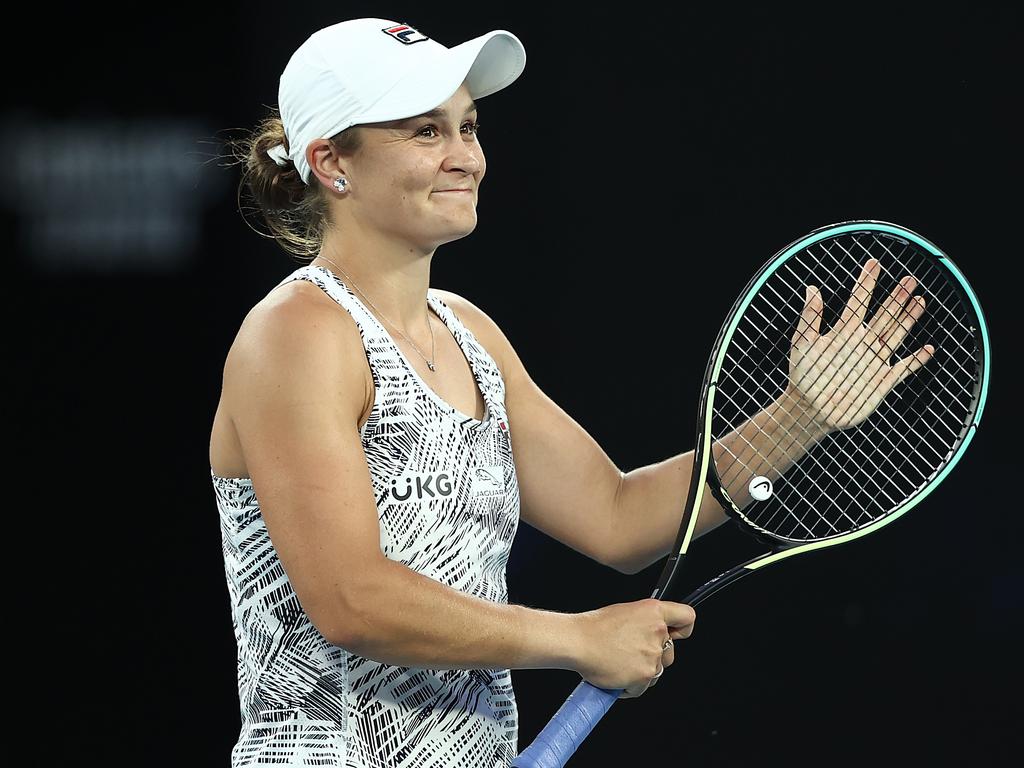
Ash Barty is from Queensland, a place beyond Daylight Saving Time since that might fade the curtains or trouble the farmers. As they say, cows can’t read clocks.
A confirmed morning person, Barty likes early starts and a baking hot afternoon sun that speeds up courts and heightens bounce. But star women’s draw billing means that, although Barty is more dog-fancier than night owl, she is learning to become the latter in a tennis sense.
The fact that the semis in the women’s draw will this year be played at night for the first time since the final was moved into Saturday prime time in 2009 means that Barty - who has already started three of her four matches in the 7pm slot - is becoming forcibly accustomed to performances under artificial light.
Not terribly late nights, though, for so quick have the top seed’s matches been (average of 56 minutes leading into Sunday night’s fourth round 6-4, 6-3 defeat of unseeded Amanda Anisimova, which was a relative marathon of 74) and how strong her pulling power at her home slam that there’s no chance of an evening session where she’s left pacing the locker-room waiting for the blokes to finish first.

And no danger, either, of courtesy cars turning into pumpkins afterwards en route to Team Barty’s rented house or a stray red Fila sneaker taking the place of a glass slipper. Although shorts-loving golfer/fiance Garry Kissick as a casual Prince Charming is not the worst fit.
Besides, winning two slams and spending 100-plus weeks as world No. 1 means the modest Indigenous girl from Ipswich has already got most Disney tales well covered before her career grand slam clock is anywhere near midnight.
After eliminating the conqueror of the defending champion, Naomi Osaka, there are three more matches to go in this one and, for the first time since Barty was seeded 18th in 2018, the majority will end up being played at her non-preferred time: night.
Using a complex system of statistical analysis otherwise known as trawling back through old draws online while clutching a pen and paper, it emerges that, from her comeback as a wildcard in 2017 until her loss as the No.1 seed in the 2021 quarter-finals, Barty has played 12 day matches compared with 11 at night.
It’s been a dramatic contrast in that same period with Nick Kyrgios, who (pause while writer consults abacus), played 15 out of 17 at night and the other two were the last singles scheduled on what is now John Cain Arena (of course) so heading towards the twilight zone. And Kyrgios’ favourite court, incidentally, has hosted 14.
The Barty majority has been on Rod Laver Arena, and — shades of Andy Murray and his traditional last-on-centre-at-Wimbledon habitat —she will play nowhere else this tournament. The 25-year-old has made a single cameo on Margaret Court’s court in her three collective Australian Opens as world No.1.

More numbers, and perhaps more explanatory ones, reveal the domestic ratings that are a big part of the reason. For Barty’s match against Camilla Giorgi on Friday, for example, the national peak 8-9pm audience was a whopping 1.686 million viewers and the average national audience of 1.346m just a bit less than double the number tuning in for Rafa’s defeat of Karen Khachanov that followed.
On Sunday, less than an hour after a football-style crowd (or zoo - both fit) urged wildcards Nick Kyrgios and Thanasi Kokkinakis into the quarter-finals of the men’s doubles, there was a bit more decorum in Rod Laver’s socially-distanced house, where its namesake was again the honoured guest in the Presidents’ Reserve.
“It’s so nice to have Rod here, first and foremost. It’s so nice to have him enjoying his own house, enjoying his own court. He was unbeatable. I’m certainly not. I’m just out here doing what I can, enjoying it, like I said, try and make my opponent’s life as uncomfortable as possible. That’s my job, ultimately, and do it with a smile, have some fun with it,” Barty said after her victory.
“Rod, he doesn’t travel as much these days. Obviously he’s an exceptional human being. He’s an amazing champion of our sport. He’s iconic. It’s just amazing to be in his presence. And in the same breath he’s also a down-to-earth Queenslander who just loves his sport.
“As Australians we are extremely lucky that he still is able to enjoy the tennis with us, and, yeah, hopefully has a few more left.’’

That Queenslander, one raised more than 600 km further north in Rockhampton but who might therefore know even more about curtains and cows, Laver was not long retired when the last Australian won the national championship.
Port Macquarie’s Chris O’Neil saluted in an era of substandard fields (Chris Evert and Martina Navratilova among the many missing, for timing and status-related reasons) and smaller draws (32 compared with 128, so three less matches to win). Which is not O’Neil’s fault, but makes any comparisons fraught.
A reluctant media subject, this reporter last interviewed O’Neil at Kooyong in 2011. She was predicting that a grand slam champion from the Sunshine State who had won a singles major earlier that year was capable of taking over a record she was happy to relinquish.
Except that she was talking about Sam Stosur, fresh from her momentous US Open title, but destined never to play her best tennis at the other hardcourt Slam - and from which she exited in a singles sense this week after 20 attempts that never extended past the fourth round.

Barty’s deepest run has already exceeded Stosur’s best result for four consecutive years, when we count Tuesday’s upcoming quarter-final against American 21st seed Jessica Pegula, whom she beat in the pair’s only previous match: in the opening round of the 2019 French Open won by the Australian.
“It‘s wonderful to see an Aussie finally up there,” O’Neil said in that chat, a decade ago.
More Coverage

“We‘ve had incredible champions in the past, but for women’s tennis in Australia, particularly, it’s been a long time between drinks now, 33 years.
“I‘ll be glad when it’s over. I do say that tongue-in-cheek, but I would really like to see an Australian win it. It’s time that it happened. I’ve been very happy to have had it for all these years but it’s time to move on now.’’
Make that 44 years. Not that we’re counting. Or even counting down. Just wondering, though, has anyone got the time?

‘I want to be happy’: How nine-year grind nearly broke Aussie star

Aus Open comeback ramps up as Kyrgios books key-lead up event

‘A bit scared’: Tennis star opens up on pregnancy journey, future plans

Williams set for Australian Open warm-up event return

How Davis Cup can revive Demon after US Open disaster
