
Novak Djokovic is holed up in a $109-a-night Swanston Street hotel while “free the refugees” protests rage outside
Novak Djokovic‘s first day in Australia was spent in an Australian Border Force hotel while his legal team fought on, writes LINDA PEARCE.

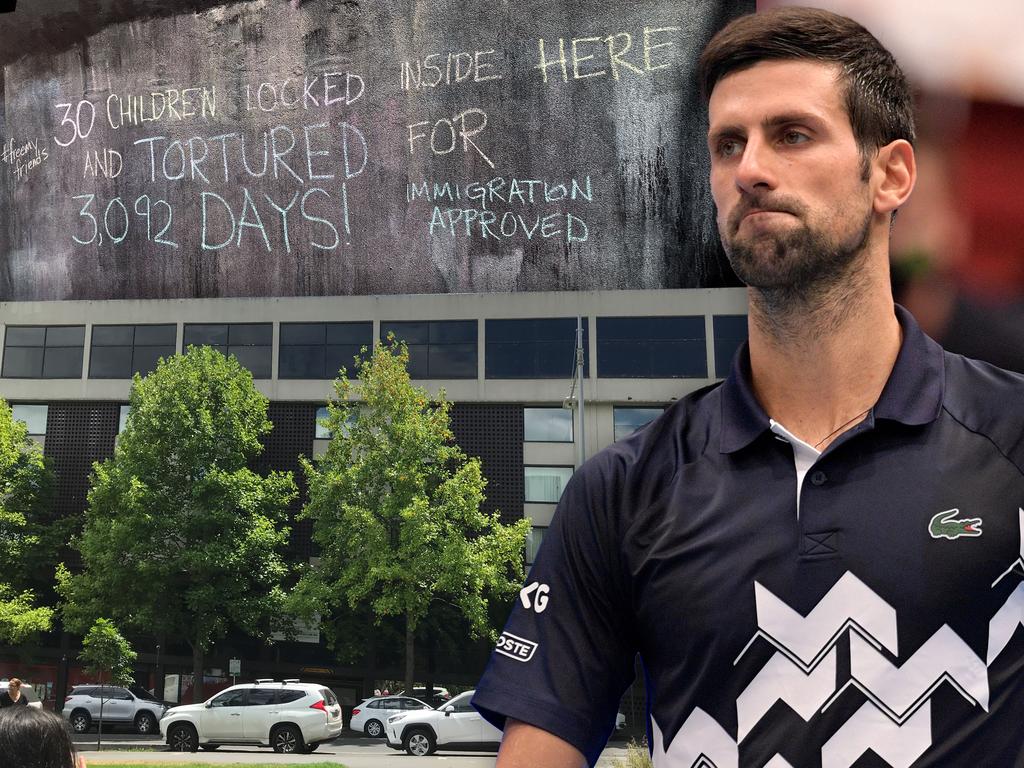
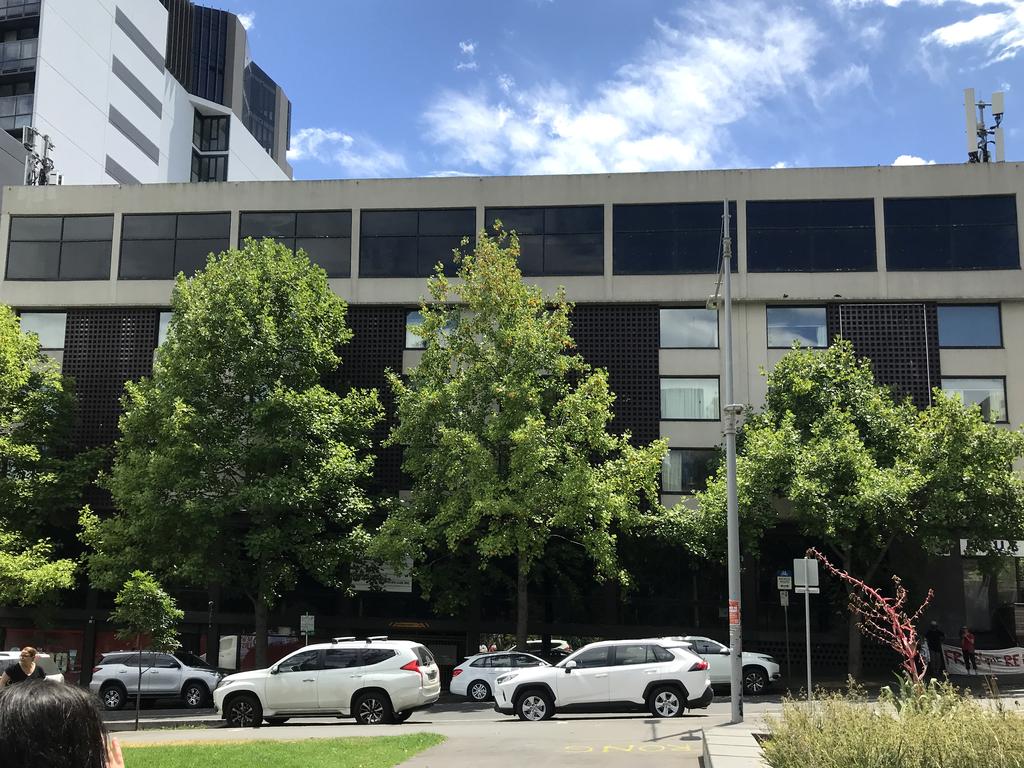
The Park Hotel at the northern end of Swanston Street advertises rooms from $109, billing itself as a contemporary establishment in cosmopolitan Carlton with amenities that include a pool, hot tub and fitness centre. There is room service and free Wifi. Smoke-free, too, for a health-conscious clientele.
For now, let’s call it the Novak Hilton.
Even if the refugee activists outside prefer their own name: Park Prison.
Up close, the latter title seems more apt. It’s not an attractive place. The sign that once heralded a global hotel chain has been covered in black plastic, and the front entry closed off so that the car park underneath with its yellow iron gate is the only way in.
It was through there to this federal quarantine facility that the world’s No. 1 tennis player, whose career prize money tops $215 million and luxury property portfolio stretches from Monte Carlo to Miami and Manhattan to Marbella as well as his native Belgrade, was taken from Tullamarine Airport on Thursday morning in a white Volkswagen van and greeted just after 10am by PPE-clad staff.
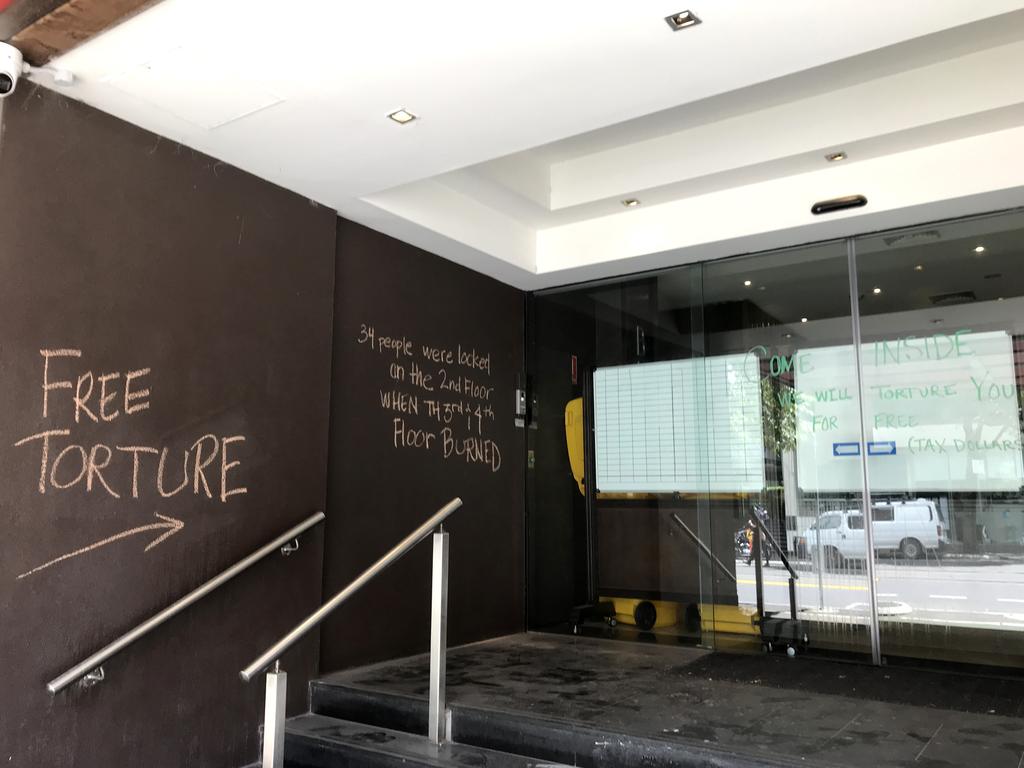
Many of the hotel’s windows have tinted coverings to prevent those outside from seeing the refugees and asylum seekers resident in some of 107 rooms - the plastic scratched off from time to time from the inside, then restored. Which, on this extraordinary Melbourne day, didn’t deter one reluctant resident holding up a “Stop the Torture Centre” sign against the glass.
It was not Novak Djokovic, incidentally. He can expect a much shorter stay via a checkout date that was being determined, simultaneously, by the Federal Court and another few nights booked, with the case having been adjourned until 10am on Monday.
The refugee at the Park Hotel who spoke to CODE had not seen any celebrity guests in the past 24 hours - but, then, since the fire two days before Christmas, three floors have been off-limits to the dozens in unending limbo, who survived a major coronavirus outbreak that afflicted more than 20 men last October in the facility that was later dubbed a “Covid incubator.’’
This refugee, who asked not to be named, is from Bangladesh via Manus Island where he arrived by boat in 2013, was transferred to Nauru and then “Mantra Prison” under since-repealed Medivac provisions. Friday will be the unhappy two-year anniversary of his stay.
Asked what Djokovic might have found when he got there, the 40-something man says via telephone: “Mouldy food and no privacy”. It is impossible to know whether these are the same conditions Djokovic is living in at present, just as it was unimaginable that a Tuesday night Instagram post of a smiling Djokovic with an airport luggage trolley could possibly have come to this.

Outside, on a humid afternoon, there are two groups of protesters: the Serbian contingent armed with flags and anger at the treatment of their favourite son; and the regulars, holding banners and placards, as they have now done regularly for several years.
Indeed, an unexpected destination for the first group is an opportunity for the second.
Deviani is a grey-haired refugee activist who has spent many days there, but never been inside. “I can’t imagine it’s great. Definitely not a five-star hotel! We think of it as a prison, and the guards just barge in on the guys any time of day for a head count.
“You can see some of the graffiti that we’ve put [on the walls]. It is torture what they’re doing to these guys. They’re not allowed to leave, not allowed to walk, not allowed to get fresh air.’’
Neither, this day, could one of the world’s most famous and accomplished athletes, much to the outrage of the assembled supporters of Serbian descent.
“I’m not vaccinated. Really. Are you going to arrest me? It’s a freedom. It’s freedom of choice,’’ says Ziggy Misovic, who is there with his wife and their red white and blue flag complete with an image of Belgrade. “Australia (should) be ashamed.’’

There is bluster about how much Djokovic had donated to the bushfire cause two years ago ($20 million, says Ziggy, over-estimating by roughly $19,975,000). Then a sarcastic thanks to Australia for “locking him down like a criminal. Like a refugee. Like a criminal… I’m so upset.’’
Told by a TV reporter that many Australians did not want the 20-slam winner here due to his lack of a Covid inoculation, the answer: “We don’t care. I don’t like a lot of Australians, but so what? A lot of Serbians, they’re gonna reject (AO) tickets back. I’m not some kind of leader, but I told them, return the tickets.’’
Meanwhile, in the background, the free-the-refugees chanting continues for the cameras that had lost interest in their cause long ago. They ask whether the tennis star will be fed the same as the less notable detainees - and, if few are listening then, as the saying goes, why waste a crisis?
Even if it’s Djokovic’s.
In the park among the gum trees is Sandra Milisic, 33. Her fury is quieter, but no less intense about the champion’s visa having been cancelled by the Australian Border Force after his medical exemption was declared invalid.
“If that was an issue to begin with, they just should have said no to him in the beginning,’’ Milisic says. “But I think more the frustration is that there are so many un-vaxed players that have had an exemption, even some who haven’t, and it’s only him that is being knocked back.’’
So, why is that? Because he flaunted his supposed exemption status, and raised ABF and government red flags? “I think because he’s very outspoken. He’s outspoken with not wanting to state his vax status…. and I think it just went downhill from there.’’
Not his usual standard of accommodation, certainly. “No, but I’m pretty sure during the Serbian war that it was worse situations, so this is nothing in terms of it.’’
Still not pleasant, though. And still utterly shocking, really, wherever the fault lies, and Djokovic must shoulder plenty. As to whether Milisic expects him to return: “Absolutely. I think the Serbian community here is so strong and so supportive and so loving that I don’t there are reasons that he wouldn’t.
“I would understand if he doesn’t come back, with the way he has been treated. But I think because of who he is as a person with the charity funds that he runs back home… and let’s not forget he was the first player to donate $1m (author’s note: well, not quite) for the bushfires, whereas Scott Morrison was overseas.’’

A lap of the block reveals cafes, a KFC and 7Eleven, a dentist and some Melbourne University buildings, while the hotel itself was once known for its dodgy bar frequented by scruffy students downing cheap pots. Upstairs, somewhere, is the world’s best tennis player, as the BBC and ABC reporters and cameras arrive to swell the media presence, and both sets of protesters remain.
Less than a kilometre away are the grand Royal Exhibition Buildings. Now being repurposed as a mass vaccination hub.
Truly. You couldn’t make this stuff up.

‘I want to be happy’: How nine-year grind nearly broke Aussie star

Aus Open comeback ramps up as Kyrgios books key-lead up event

‘A bit scared’: Tennis star opens up on pregnancy journey, future plans

Williams set for Australian Open warm-up event return

How Davis Cup can revive Demon after US Open disaster
