
How Nick Kyrgios has, and hasn’t, changed since his last Wimbledon quarter-final appearance
Eight years ago, teenage Nick Kyrgios shocked Wimbledon by beating world No.1 Rafael Nadal. Back in the quarter-finals again, much has changed yet one thing never will, writes ADAM PEACOCK.

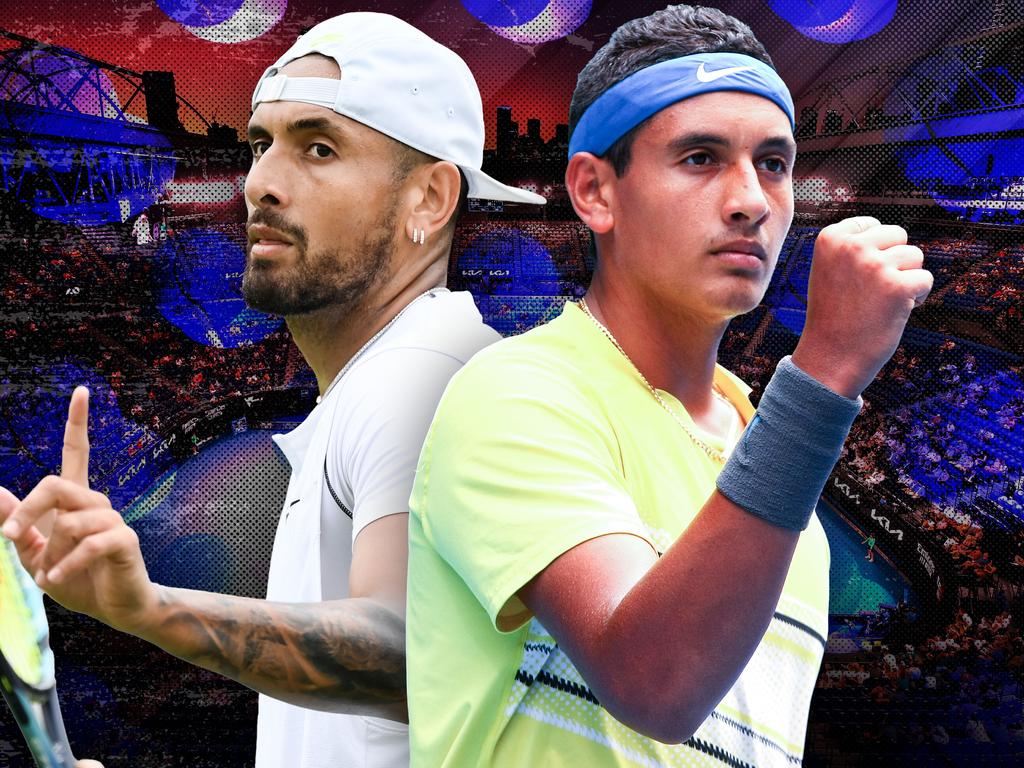
After eight years, 282 matches, 282 quotable press conferences, more than $1 million in fines, zero coaches, ups, downs, arounds, tweeners, tantrums and tirades – suddenly Nick Kyrgios is back in the quarter-finals of Wimbledon.
In 2014, Kyrgios burst into the mainstream with an astonishing take down of then-world No.1 Rafael Nadal.
“There’s a lot of room for improvement,” a fresh-faced, well-mannered 19-year-old Kyrgios smiled afterwards.
“I think in the future … you know, of course I can go a bit further.”
He’s not been proven wrong, but until this point there’s been as much doubt as noise heard every time Nick Kyrgios steps on court and then in front of a microphone. The past eight years are impossible to pack neatly into anything coherent.

The five-set win over a valiant Brandon Nakashima was a long way from the ‘I’m here now’ performance against Nadal in 2014.
Kyrgios looked neutered for most of his three hours on court against Nakashima. Grabbed his shoulder. Stayed quiet. The Royal Box didn’t get so much as one card of Kyrgios’ five-card trick. No four-letter royal flush to make them blush.
Only late on, when one of his entourage casually asked Kyrgios to maybe land a few more first serves in, did any sign of agitation emerge.
“Think I’m not trying to do that?” was the gist of his retort, unable to be heard clearly as TV commentators routinely talked through sit downs, to drown out the potentially explicit words.

As his mood threatened to turn blue, Kyrgios’ hat went fluoro green, the sponsors’ label smudging the otherwise white cap. Wimbledon is stricter than an Amish parent about attire. White or you’re off-court. Players are chucked off practice courts with the mere sighting of a big logo.
In the bowels of centre court, one can imagine the tournament referees having a discussion about Kyrgios’ light green hat, like a couple of zoo vets working out who will jump in to solve a tiger’s tooth ache. “You go do it. No you. Get stuffed, it’s your turn.”
In the end, Kyrgios and his smudged hat got through, before clothing became the focal point of the encore; the press conference.
A tabloid journalist rattled his cage about his red and white Air Jordans and coloured cap worn for the walk out and walk off, which Kyrgios has worn for all his matches this year at Wimbledon without reprimand. The questioning became splendid fodder for Kyrgios to take control of the internet for another day, dealing the trump card of a generation, ‘champing’ his inquisitor before throwing in a wink for free.
This is how it plays with Kyrgios. Win or lose, there are questions. Ever since the Nadal victory in 2014, when expectations got reset forever, Kyrgios never quite lined up with conventional wisdom opined by others about how he should behave and prepare to achieve his own greatness.
For a while, every match was measured against the Nadal win. Every loss, occasionally in a blaze of vitriol, came with an obtuse reaction.
Last November, all relaxed and content back in Canberra near a basketball court and mates, Kyrgios told CodeSports how reaction to his own behaviour from total strangers altered his mood on an hourly basis, as he spent way too much time staring into the digital abyss.
“Wake up, see Instagram, see negative comments. They don’t really affect me but are still going into my brain. You have to be a certain type of person to block that out,” Kyrgios said.
“It was everything external for me, the bad media, the negativity, the toxicity, the racism, that’s what was hard to deal with.
“I know who I am now, it doesn't affect me too much to be honest.”

Kyrgios’ coping mechanism was to say he didn’t care about results.
“When I get old I’m not gonna be like, remember that time I made the quarter-finals of the Australian Open. I don’t really give a f--k to be honest,” he said.
The fascinating part is how much care there is about how much he cares.
And when it looks like Kyrgios doesn’t care, and starts with the modern day McEnroe routine, weird things happen, like columnists requesting he be deported.
Of course, Kyrgios does care. His fitness levels for this tournament reveal a detailed preparation.
More ominously for those who worry what Kyrgios is doing to the sport, the 27-year-old is now mature to the idea of his own value.

The Australian Open doubles extravaganza with Thanasi Kokkinakis gave a clue. How Wimbledon, wrongly painted as a place of stuffy tradition, is quite happy to make Kyrgios the centrepiece of its online offering is confirmation.
Highlights of the Tsitsipas match, in the eyes of the Greek fourth seed a triumph for evil over good, quickly crashed through the million mark on YouTube. The overnight ‘champing’ tweeted by the BBC got more than 500,000 within two hours.
Where is men’s tennis heading without Federer, Djokovic and Nadal, coming to a court near you soon? Carlos Alcaraz and Jannik Sinner are two brilliant young talents already able to deal with the physical suffering of chasing a little fluffy ball around with a racquet. That is where their talking starts and stops.
Kyrgios is acutely aware his personality is a commodity. Would tennis exist without it? Yes. But with it, can it be harnessed into something financially beneficial for all? Hell, yes.

For two decades, TV rights for the majors have inflated at a rate higher than a South American currency during a coup, all thanks to the era of the greats.
Kyrgios won’t win 10 grand slams, but he’ll be a big reason why those rights keep climbing in value.
And when he walks out, maybe in a white hat and shoes, for his quarter-final with Chilean Cristian Garin, there will be one similarity between the present and eight years ago.
Nick Kyrgios is impossible to ignore.

‘Very lonely mission’: The price of being a teen tennis star

Federer to return to Aus Open for ‘battle of the World No.1s’

Ultimate wildcard: Mystery still surrounds Kyrgios AO plans

Titmus sought out Barty for advice on early retirement

Demon’s vow after taking out top tennis honour for fourth time
