
How Nick Kyrgios went from ‘hungry’ kid to Wimbledon final opponent for Novak Djokovic
Nick Kyrgios’ transformation from chubby kid to Wimbledon finalist has been one of wild fluctuations, including his feelings towards opponent Novak Djokovic, writes LINDA PEARCE.


Ash Barty is not particularly fond of her signature childhood tennis photo. You know the one: her cute little six-year-old self holding a trophy and a racquet at the humble West Brisbane Tennis Centre, which quietly closed its doors last month.
Nick Kyrgios just posted his own pic to his 2.6 million Instagram followers and it’s another that many have seen before. On Friday, in his pre-finals Wimbledon media conference, the image of that chubby kid prompted a question about what young Nick was like.
“Hungry. I was hungry,’’ Kyrgios quipped. “Yeah, I think it’s just hilarious because, like, I don’t think I’m supposed to be someone like me. Like, I look at that photo, I grew up in Canberra, the courts I trained on were horrible, and now [I’ve got the] chance to play the Wimbledon final.”
“I think it’s honestly an inspiration for any sort of kid who’s kind of been outcasted or just been surrounded by negative headlines or negative clouds or … just being brought down from a lot of different angles. I feel like it’s possible, it’s still possible to achieve something quite special if you just believe in yourself.
“I never really lost belief in myself. I feel like most people around me at some stage in my life have lost belief that I would ever make a grand slam final, doubted me a little bit in my behaviour or just the way I trained. I think everyone, it’s safe to say. That’s fine they doubted me, but I never lost belief in myself.
“I think that’s just a strong message for any kid who doubts himself. Just keep going. Look at that photo, I literally look like Manny [Delgado] from Modern Family.’’

Then he grew. Slimmed down. Like triple major winner Barty, Kyrgios had long been the kid being talked up in local tennis circles as an outrageous talent capable of having his name added to honour boards and engraved on the sport’s most prestigious trophies. Now, almost shockingly, that destiny is one match from being fulfilled.
“I’ve known Nick a long time,’’ says former world No.15 and coach, now commentator, Wally Masur. “I’m from Canberra, someone rang me up from Canberra and they said Wally, I’ve just met a 13-year-old kid who’s going to smoke anything you did on the tour, and I said, ‘Who is it?’ And it was Nick Kyrgios.’’
Yet also like Barty, who battled mental health issues that prompted her to walk away from the game before her triumphant return and surprise early retirement in March, the 27-year-old’s path has been far from linear.
Never less than compelling, though, while frustrating, thrilling, fascinating, infuriating and wasteful are other descriptions that fit the Kyrgios narrative.

The world No.40 has been honest enough to admit this week he has had enduring questions to answer over whether he had the mental capacity, physical fitness or discipline to go this deep at a major.
And yet, with the help of a free pass from Rafael Nadal into Sunday’s climax against Novak Djokovic, the 20-slam man he leads 2-0 head-to-head, Kyrgios is now where his rare shot-making ability was always capable of taking him.
Djokovic, meanwhile, is where he usually is, and yet another Wimbledon title would be his seventh.
“Bromance’’ or no bromance, may the best villain win.

*****
Before the biggest singles match of his career, Kyrgios has acknowledged the role of juniors and doubles in getting him to the duel with Djokovic he labels, with typical humility, as “mouth-watering”.
As a powerful 17-year-old, Kyrgios beat his great mate Thanasi Kokkinakis to win the 2013 Australian Open boys’ title, before and after his two successes in the Wimbledon doubles. Yet for all the bravado about belief, emulating those results at senior level was not something the world’s No.1 junior thought was possible.
“I can’t give enough credit to juniors, what it did for my confidence. Being around the grand slams at that young age, being around some of the top players, the facility, I don’t think I would have had the breakthrough in the men’s so quickly.’’

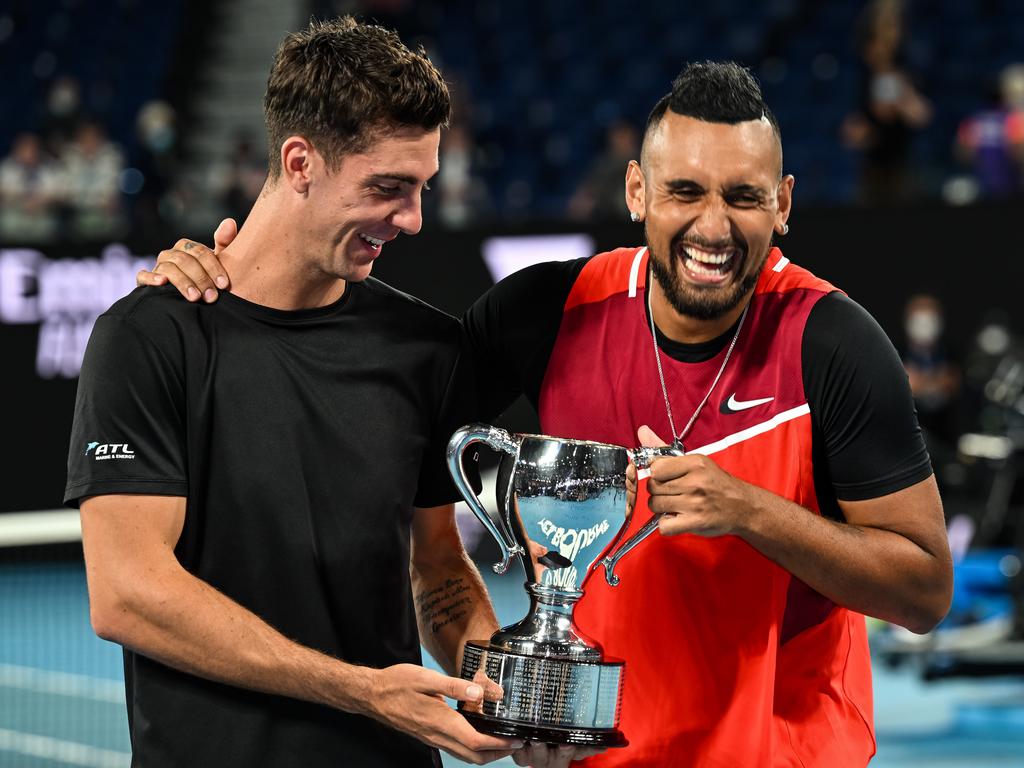
Nor did he ever imagine winning a major doubles title. Until, with Kokkinakis in January, the box-office drawcards known as the Special Ks promptly, and outrageously, did.
While clearly less physically demanding than singles play, the popular victory delivered some more mental lessons to Kyrgios, who embraced at his home slam what he calls the “mundane” routine of matches alternating with practice days for two solid weeks.
“I realised in Melbourne it’s a long time. Like, it’s a really long time in one place,’’ says Kyrgios, who is renting a house in the Wimbledon Village with partner Costeen Hatzi, dad and cook Giorgos and two friends.
“You can’t explore, you can’t really go to the city here. You can’t enjoy your time as much as you would like to. You kind of have to stay in your house, be reserved, take your mind off things.
“I think in Melbourne I really realised that. Even at a doubles grand slam, you do really need to just get your stuff done quick and clinical, then just rest. I felt like earlier in my career, I didn’t realise that these days off and the practise is so crucial.
“Like, I beat Paul Jubb 7-5 in the fifth set in my first round, and now I’m in the Wimbledon final. You just have to ride the waves, roll with the punches in a grand slam.
“Like, you just don’t know. You really don’t know. You could be four points away from losing the tournament, then 11 days later you’re in the final, so … I just feel like I kind of just take it as it comes now more so than what I used to.’’
Sounds suspiciously like maturity. Hope so. We shall see.

*****
It will surprise absolutely no one that almost a decade of writing about Kyrgios has been a wild ride at times.
While it started relatively calmly, there was always a colourful, combustible side. Indeed, even back in 2013, the AO boys’ champion admitted to noticing in senior qualifying the lack of anger and negativity among the older professional cohort he could match for ball-striking but not, yet, temperament.
Perhaps it all came a little soon for Kyrgios. While he bettered his goal of a top 300 finish that year by more than 100 rankings places, few were prepared for what would unfold at Wimbledon in 2014: the audacious, exhilarating upset of Nadal that even his mum Nill did not believe was possible. Yet.
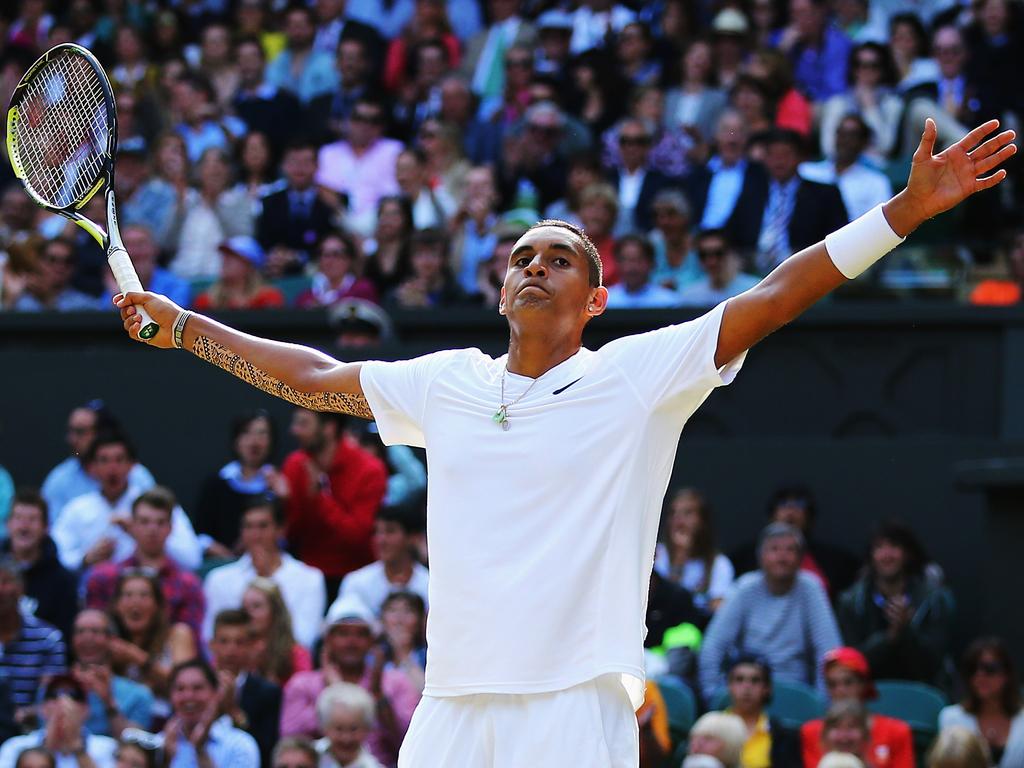
This was the stage he appeared born to strut, while the interview room was not yet the combative place it would eventually become. The self-described “normal 19-year-old kid” who travelled with his X-box and a roster of family members to help ease the pangs of homesickness reflected on the highlight of his breakthrough major after arriving back at his training base in Melbourne.
“Um, probably going to Chipotle Mexican Grill every night with my friends and family. Every. Single. Day,’’ he grinned during a long and candid interview. Not shaking hands with the world No.1 after crushing him on centre court? ”Nuh. Just Chipotle. It’s the best place in the world.’’
As opposed to Melbourne’s northern suburbs, it seems, where he was living at the time and where, post-Wimbledon, he had asked the Twitterverse: “Anyone wanna chill in Bundoora tonight?” Hashtag: “Bored.” When some local university students replied, Kyrgios and his pal Harry Bourchier turned up to hang out. As you do.

Things got more complicated, though. And much darker, too, as we now know. Too much to trawl back through, but the rap sheet ranges from tanking to sledging to Olympic boycotts, tantrums, lewd gestures, umpire abuse and regular self-destruction.
During that period, this writer’s interview requests were denied by Kyrgios’ then-management company, on the basis that it was obvious, apparently, what I thought of their high-profile client. Which was interesting given that I hadn’t yet worked that out.
Even then, opinions on specific incidents or the less savoury aspects of his behaviour did not equate to a concrete view on Kyrgios himself. And still don’t. He’s often likeable. Pretty much always a must-watch.
Yet, given that one person’s authentic and unfiltered can be another’s definition of a disrespectful brat, could there be a better example of the almost random pros and cons than this past fortnight?
Spitting. Claims of bullying on the court and domestic violence allegations off it. Flirting with, and bellyaching about, the all-white clothing rule. Unedifying behaviour during several media conferences, mixed with some welcome soul-bearing and that odd bromance business.
All against the backdrop of some mesmerising, occasionally breathtaking, tennis. Played like he’s trying. Hard.

Masur, the former Davis Cup captain, describes his former charge as “very complex, very hard to get to know’’, which was why he found the media conference after the quarter-final defeat of Cristian Garin match so interesting.
“He kind of let us in a little bit,’’ Masur said on Nine on Friday. “He talked about how he felt he’d let some opportunities slip, maybe hadn’t done things the right way. He thought this ship had sailed. He is such a unique individual. He’s a contrarian; you never know what you’re gonna get.
“But, OK, he does love the sport. He’s been a good player for a long time. I think he quite enjoyed winning the Australian Open doubles title with his mate Thanasi. That taste of success I think has spurred him on to really focus on this year’s Wimbledon.’’

Masur, who was most recently Tennis Australia’s head of professional tennis, spoke of how expectant and optimistic many former players had been about the kid from Canberra who is suddenly within one match of achieving what only 13 Australian men — and three women — have done before.
Lleyton Hewitt (2002) and Pat Cash (1987) were the most recent, while Pat Rafter reached two finals at the All England Club and Mark Philippoussis in 2003 lost the last.
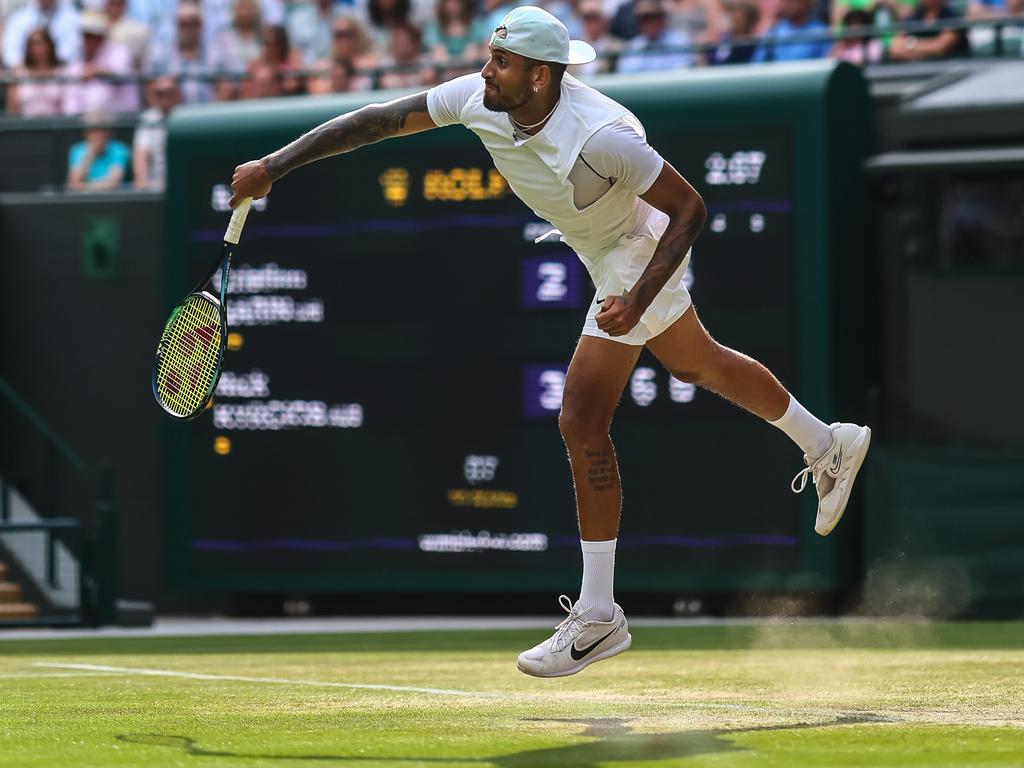
“Pat Cash was always going to win Wimbledon,’’ says Masur, who believes Kyrgios will benefit from the extra rest day granted by the Nadal walkover. “When I saw Nick as a teenager I thought, ‘This kid will win a major. He has to, with the game that he’s got’.
“And he’s getting very, very close to delivering.’’
*****
Twelve months ago, that sweet photo of six-year-old Barty was widely juxtaposed with the image of the Queenslander holding the Venus Rosewater Dish as Australia’s first female singles champion since Evonne Goolagong Cawley in 1980.
Back then, the injured Kyrgios would have been given almost no chance of emulating his more dedicated but similarly gifted compatriot just one year later.
Then again, the idea of a mutual admiration society with old foe Djokovic would have been unthinkable, too.
Kyrgios is nothing if not changeable, though. After the 2013 junior final at Melbourne Park, he was asked to tip the winner of the senior final between Serbia’s two-time defending champion and Scot Andy Murray – now a pal and sometime mentor – the following night.
Answer: “I want Djokovic to win.’’ Five words that would have been unthinkable as recently as early January.
Fast forward again. To day 14 of The Championships. To two opponents now sharing a less-grudging respect, chummy Instagram messages and a Wimbledon final.
Strange days, indeed.

‘Very lonely mission’: The price of being a teen tennis star

Federer to return to Aus Open for ‘battle of the World No.1s’

Ultimate wildcard: Mystery still surrounds Kyrgios AO plans

Titmus sought out Barty for advice on early retirement

Demon’s vow after taking out top tennis honour for fourth time
