
Inside Carlos Alcaraz’s coronation as Wimbledon’s new king, with final defeat of Novak Djokovic
The Wimbledon crowd chanted Carlos Alcaraz’s name as he completed the dethroning of Novak Djokovic, a triumph of historic proportions and frank observations. COURTNEY WALSH was there for an epic final.

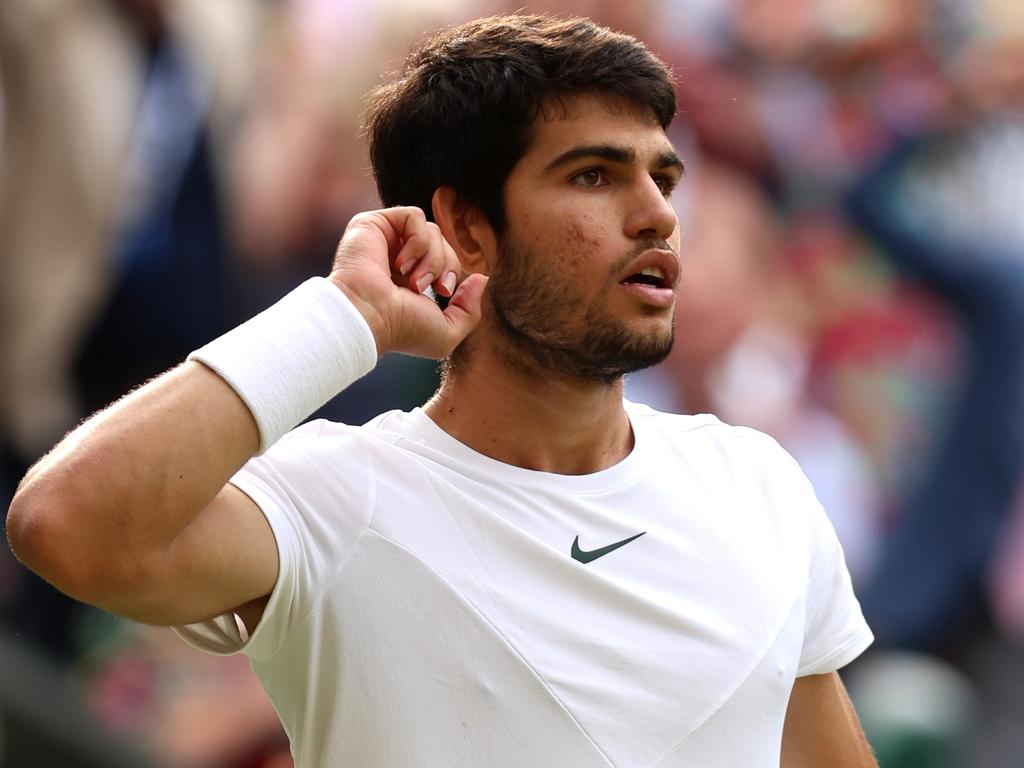
Carlos. Carlos! CARLOS!
As the coronation of a new king at Wimbledon edged closer to becoming a reality, the chorus of celebration reverberating around centre court grew increasingly deafening.
On Sunday in London, Carlos Alcaraz etched his name onto the most famous honour board in tennis with an astonishing 1-6 7-6 (6) 6-1 3-6 6-4 triumph over Novak Djokovic.
For the first time since 2002, the men’s champion is someone other than the remarkable quartet of Djokovic, Roger Federer, Rafael Nadal and Andy Murray.
If Alcaraz represents the future of tennis, then the sport is in the very best of hands, such is the manner with which the 20-year-old plays and conveys himself on and off the court.
Djokovic was chasing history. Another victory would have seen him draw level with Federer as an eight-time champion at the All England Club, a feat that is remarkable in itself.
More importantly, having conquered Melbourne for the 10th time and then claimed a third Roland Garros title in June, the 36-year-old was tracking towards a calendar Grand Slam.
Unbeaten on centre court in more than a decade and chasing his fifth Wimbledon title in succession, Djokovic was a heavy favourite.
Alcaraz was tasked with Mission Improbable. And then he dropped the first set 6-1.
Yet the Spaniard rallied in remarkable fashion to win the second set tie-breaker, ending Djokovic’s tie-break winning streak in majors at 15, and then again early in the decider under immense pressure.
What does it take to defeat the Serbian superstar on centre court at Wimbledon?
A superhuman performance. And that is what Alcaraz produced against the all-time legend.
From twists and turns to incredible momentum shifts, scintillating forehands, flashes of anger and even an analysis on the importance of butt cheeks in tennis, this epic had it all.
The Alcaraz triumph in the end was born on a barrage of winners – he clubbed 66 to his rival’s 32 – and superb courage when under fire early in the deciding set.
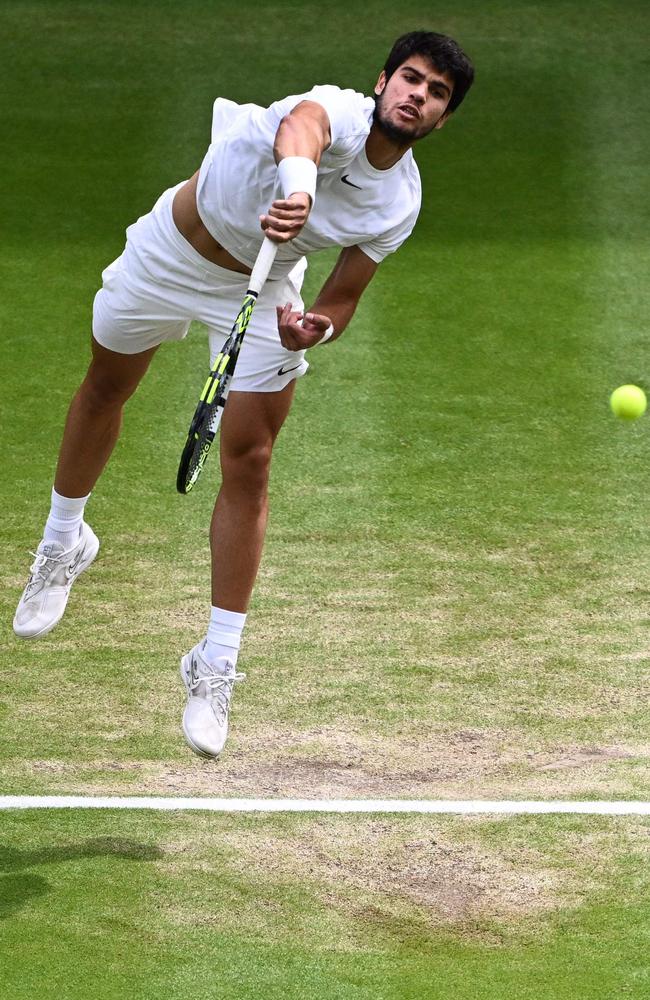
There were some points where all the superlatives in the Oxford Dictionary could not adequately describe what had eventuated, nor speed guns capture the thunderclap that sounded when Alcaraz rounded into a forehand with time on his hands.
Under a grey sky at 6.49pm, the world No.1 stepped to the baseline for a defining moment in his career. The chance to serve for the Wimbledon championship. The truest test of nerves.
He failed on the first point with a drop shot. The crowd inhaled sharply. Would this be a triumph? Or would it prove disastrous?
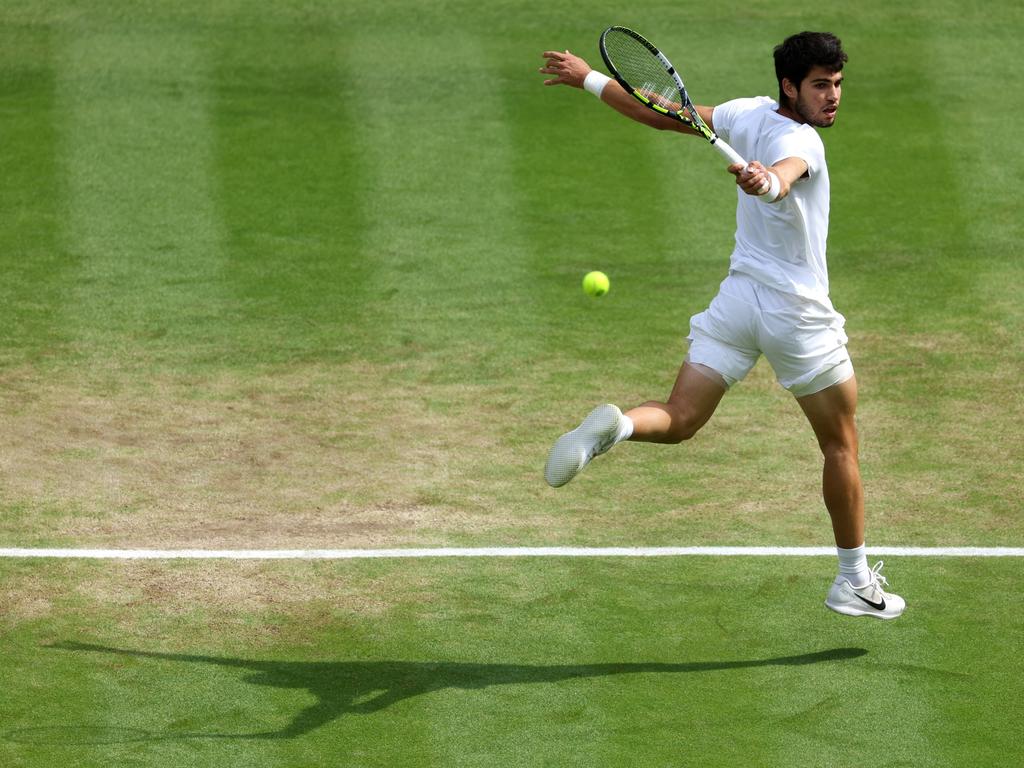
But typical to the verve with which the right-hander plays, he backed himself in with another on the very next point, drawing Djokovic in before whipping a topspin lob.
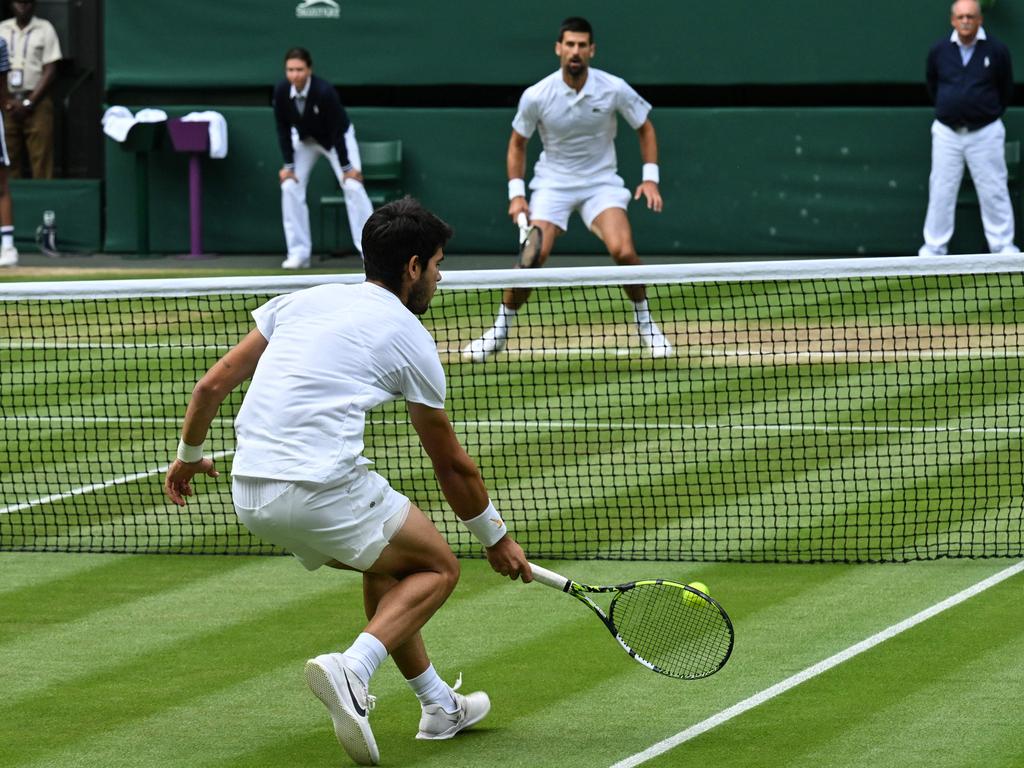
A lunging backhand volley that deflected a Djokovic bullet put him within two points.
The old king responded with a forehand winner. 30-all. But then Alcaraz thundered a serve.
Match point. Bang. Another first serve. Then a forehand fired. And when the old warrior netted a bunt back, it was all over. A new king was crowned. Long live both kings.
“I have fallen in love with grass. It is amazing. I didn’t expect to play at this level in a really short period. I have played just four tournaments on grass. It is a dream come true,” Alcaraz said.
At 20, Alcaraz is the third-youngest Wimbledon champion behind Boris Becker and Bjorn Borg. He fits well in that company, such is the aura of superstardom he already possesses. And anyone fortunate to witness this decider, and the manner with which it was fought and finally won, will be discussing it in awe for many anniversaries to come.
It was extraordinary, as Australian legend Rod Laver noted.
“Congratulations on your first Wimbledon crown, Carlos Alcaraz,” he posted on social media.
“You certainly found your feet on grass this summer, an astonishing achievement against one of the greatest champions ever, Novak Djokovic. I’m sure there will be many more magnificent battles between you two.”

*****
The anticipation around London on the morning of the final was evident in cafes and at tube stations. And the topic of conversation was common. Could the challenger topple the king?
It was a match pitting a legend against the heir apparent, a 23-time major champion against the explosive newcomer who has usurped him at the top of the rankings.
Wimbledon’s advertising agency moved as swiftly as both men covered centre court.
When exiting select railway stations, Londoners would walk through gates featuring the world Nos. 1 and 2 exchanging burning looks of desire and intent.
In the suburb of Tooting in the south, Djokovic’s sponsor Lacoste had already claimed prominent advertising space proclaiming the Serbian’s “iconic” status.
But up in Wimbledon Village, a local Spanish restaurant was all stocks in on Alcaraz, welcoming those heading to brunch with a message of support for the US Open champion.
A Western Australian visiting Wimbledon for the first time snuck a look at tickets on the morning of the final, just in case a fan had lost complete command of their senses.
But at a cost of $15,000, they decided Murray Mound was a more cost-effective option. By the end of the afternoon, their ear drums had been deafened by the roars there.
It was the hottest ticket in the United Kingdom and drew global stars to SW19, as scents of expensive perfume and champagne and, of course, strawberries wafted on the breeze.

The final started under grey skies but there is nothing remotely bland about a Wimbledon decider, with centre court proving a kaleidoscope of colour amid the star gazing.
The vividness of the most prized patch of turf in tennis contrasted with the browning footmarks around the baseline which had worn to dust throughout the fortnight.
Photographers lined the courtside pits, craning their necks to capture the silver screen stars in between the breaks between points and games, in a final that turned into a thriller.
In the Royal Box, the Prince and Princess of Wales, who is the patron of the All England Club, sat in the front row alongside their family. The King of Spain was also in attendance.
Dual champion Murray, the last man to beat Djokovic on centre court, in the 2013 decider, sat alongside his mate Neil Skupski, who had won the Wimbledon doubles title on Saturday.
Actor Ariane Grande wore a white Wimbledon cap. Brad Pitt sported sunglasses and an open-necked aqua top. Hugh Jackman opted for a white T-shirt under a navy blue suit jacket. And Daniel Craig was dressed, of course, as suavely as James Bond.
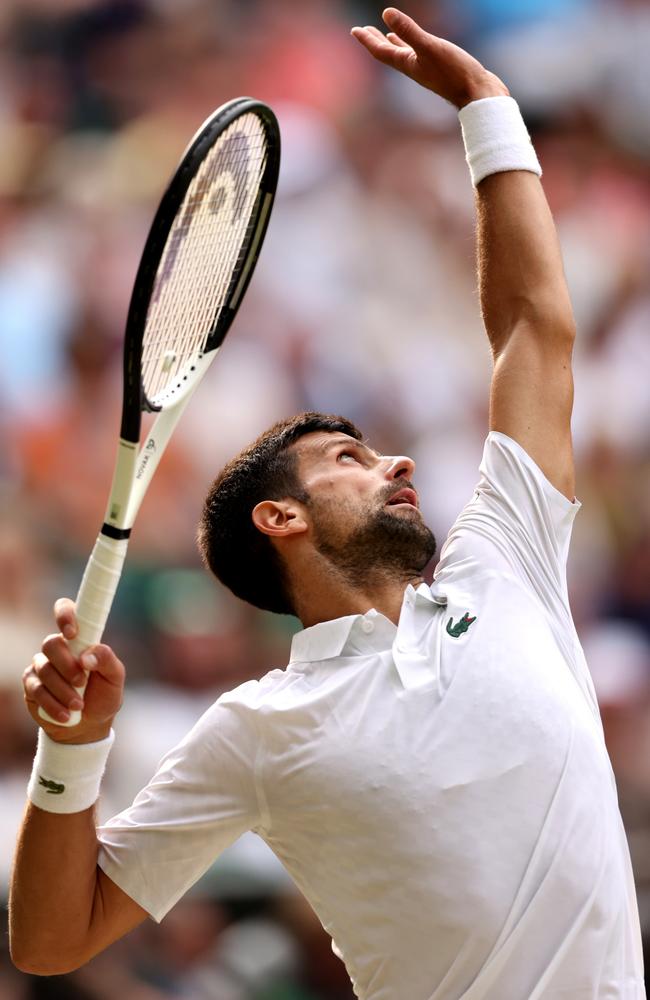
Novak Djokovic presents as his tennis equivalent. There was not a crease out of place on his clothes as he stepped out in pursuit of Wimbledon title 008.
It was hoped this would be an epic to match Djokovic’s remarkable stoush with Federer in 2019. But occasions such as this do not always live up to the billing.
Only a month ago, the two squared off in a Roland Garros semi-final that equalled the hype for the first two sets, only for Alcaraz’s body to betray him as he fell prey to the pressure.
Would an epic ensue here?
*****
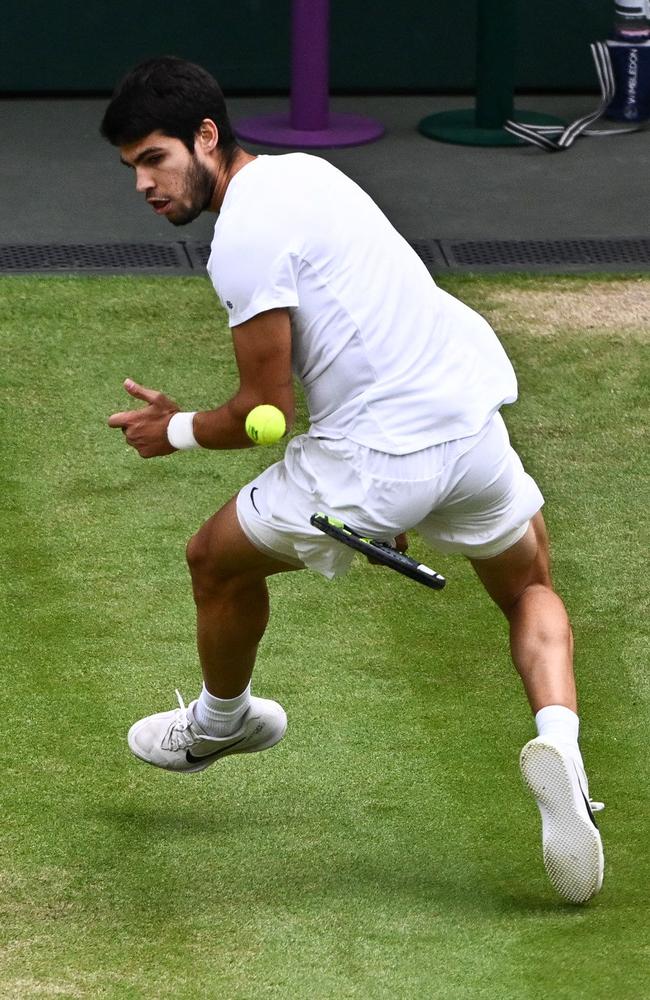
“The cheeks. It is all about the butt cheeks.”
It is not the type of analysis one might expect on the BBC shortly before the men’s final.
But so said 1987 Wimbledon champion Pat Cash, his Aussie accent still strong despite decades travelling the world, as he spoke with admiration about Carlos Alcaraz’s bottom.
Sorry. What? Cashy has never been shy in challenging convention, but did this ring true?
Yep. Alcaraz is blessed with a fine “derrière”, John McEnroe confirmed with a nod.
Both men were in agreement that the blistering blasts Alcaraz had conjured with his forehand throughout the fortnight began with the calibre of his butt cheeks.
“The second-strongest muscle in the human body is the glute muscle,” McEnroe said.
“He is rotating into the ball while tightening the ‘you know what, the derrière’ and it adds up to the hardest forehand I have ever seen.
“He is the most exciting thing to happen to tennis in 10 years (and) he plays with an exuberance and a love of the game.”
Similarly to everyone else in attendance, the old champs were beaming ahead of the final.
“I am so excited for this match. It is going to be buzzing,” McEnroe said.
*****
Blink and you might have missed the first set, so swiftly did the four-times-straight defending champion assert his authority after surviving a break point in the opening game.
Leading into the decider, Alcaraz had spoken with astonishment at Djokovic’s imposing record of reaching 35 grand slam finals.
In contrast, the Prince from Murcia was competing in just his fourth grass court tournament, though the Spaniard had cottoned on fast to the intricacies needed to succeed on the surface.
Having survived a tough tussle in his opening match at the Queen’s Club last month, he went on to defeat Australian Alex de Minaur in the final. And he got better and better.
After a comprehensive semi-final defeat of Russian Daniil Medvedev, the Juan Carlos Ferrero-coached champion said he would do his best to ignore the reputation of the man standing opposite him.
“It is crazy. But I will try to forget everything about this. It is not time to be afraid. It is time to go for it,” he said of facing Djokovic.
But having won the coin toss, Alcaraz instead elected to receive.
And while he had a break point in the opening game, it seemed the bravest of gambits to give his rival an early advantage.
Alcaraz was errant in the first set. He was swinging hard and fast, but his control deserted him in making nine unforced errors to Djokovic’s two as the first five games flashed by.
Djokovic, in contrast, produced phenomenal tennis. It was a masterclass in grass court play, with the veteran dictating the tempo while intimidating the student.
The seven-time champion played with aggression, not prepared to give his younger rival any time to wind into his explosive forehand, nor to let him settle into the rhythm of his first final.

*****
The resurgence began at the start of the second set.
When Alcaraz snared a service break in the second game, in part due to some fortune with the net cord, the crowd roared to life. It was evident that it was firmly in his favour.
But a service break often proves fool’s gold against Djokovic. He takes it as a personal affront and raises his level to douse an opponent’s optimism almost immediately.
Once again, the Serbian bounced straight back to retrieve it and bellowed a guttural roar on doing so, not long after clinching an edgy rally lasting 29 shots.
Djokovic’s desire to keep his foot on the throat of his rival, and the crowd out of the match, was apparent. But the punishing exchange was a pointer of what was to come.
Alcaraz had his chances when leading 5-4, yet a couple of questionable decisions combined with the Serbian’s incredible court coverage saw those opportunities go begging.
Roger Federer was said to play a point as a chess player, setting it up to poach the queen three shots in advance from the one he had just struck.
Sometimes, it seems as though Djokovic must have a channel directly to the minds of his rivals, so often does he seem one step ahead in pursuing their next shot.
When not assessing Alcaraz’s buttocks, Cash said he had once attended a master conditioning coach in Los Angeles that Djokovic has also used.
The coach told Cash that dozens of athletes he had mentored would outsprint the Serbian star in a 10-metre dash. But he had never seen anything as extraordinary as the legend’s reaction time when it came to tests of hand-eye coordination. It was effectively unworldly.
When reflecting on where the match turned Alcaraz’s way, it is impossible to ignore the importance of the tie-breaker, given what unfolded and also Djokovic’s imposing history.
The Serbian had won the previous 15 tiebreakers he had played in grand slams. He is the most successful player in the decisive stanzas in the history of the sport.
When he moved to a 3-0 advantage, Alcaraz’s hopes looked forlorn. But as he rose to the occasion, the champion began to lose his air of invincibility.
Serving at 5-4, Djokovic was issued with a time violation. It was overdue; not that he believed it was the correct call.
Then the unthinkable happened. Djokovic missed a backhand holding set point. And another. Alcaraz struck with a beautiful backhand return passing shot. What a ripper.
As he walked to the chair, with his hand cupping his right ear to head the rapturous ovation from the crowd, it was clear the challenger was now a legitimate contender.

*****
With his conviction deflating, Djokovic started the third set in disastrous fashion by dropping his opening service game with a backhand error.
Another fork in the twisting road of this final was reached at 3-1, in a game that lasted 26 minutes, just eight minutes fewer than the first set took to resolve.
After 13 deuces and one of the mightiest single-game arm wrestles seen at Wimbledon, it was the Spaniard who emerged with the upper hand as the crowd rose to their feet again.
It sparked a surge from Alcaraz, who dashed through the next two games with a loss of just two points.
He was cracking forehands and clubbing backhands and, when approaching the net, it was a case of crushing-and-rushing as opposed to chipping-and-charging.
Heading into the fourth set, it was Advantage Alcaraz.
*****
To some tennis fans, Novak Djokovic will always be as popular as Darth Vader, despite his remarkable performances on the court and his forays into charity in his homeland.
A lengthy toilet break lasting nearly seven minutes between sets did not endear him to a crowd already well and truly behind Alcaraz, given his breathtaking play.
By the time the enduring champion returned to the court, the crowd was chanting his rival’s name yet again. Carlos. Carlos. CARLOS!
For a moment, one pondered whether Djokovic would ever return given the third set onslaught. And he was booed by some patrons, far from impressed by the delay.
In his opening service game for the set, Djokovic slipped for the third time, finding himself face down on the court he has owned for a decade as another winner zipped by him.
If this was a boxing match, the champion might have been counted out. Instead, he saved two break points, regained his breath and revived himself.
Alcaraz had looked the better player until he missed a simple forehand volley when serving at 2-all, 30-15. And far from flagging, Djokovic all of a sudden found another wind.
He was able to wrest the momentum when dropping a delicate backhand to the incoming Alcaraz’s feet on break point.
Djokovic immediately turned to the crowd who had been blowing raspberries to him at the start of the fourth set and blew a kiss straight back to them.
Not for the first time in his extraordinary career, it was Novak versus an exceptional opponent versus a crowd now turned against him. And that fuelled his fire.
He made a critical adjustment. In the first three sets, he struck just under one third of his shots from inside the baseline. In the fourth, Djokovic increased this to almost 50 per cent.
When the Serbian broke again to close out the fourth set, the momentum seemed in his favour. And from afar, former finalist Andy Roddick declared: “This is an insane level of tennis.”
*****
The centre court crowd was on edge. And so were the combatants. When Djokovic saved a break point to open the set, it appeared an eighth Wimbledon title was in sight.
But when Alcaraz conjured an incredible escape in a similar situation in the following game with superlative defence, Djokovic looked towards him in disbelief.
This was an example of the superhuman type of effort needed to upset the Serbian and the star from Spain was up for the challenge. It changed the tempo again.
After an outstanding rally on break point – with Djokovic slipping and then rising to regain control, only for Alcaraz to bludgeon a backhand passing shot winner – the break was his.
In frustration, Djokovic obliterated his racquet on the net post, earning the ire of umpire Fergus Murphy and the anger of the crowd, which was celebrating the ascension of a new shining star.
More Coverage


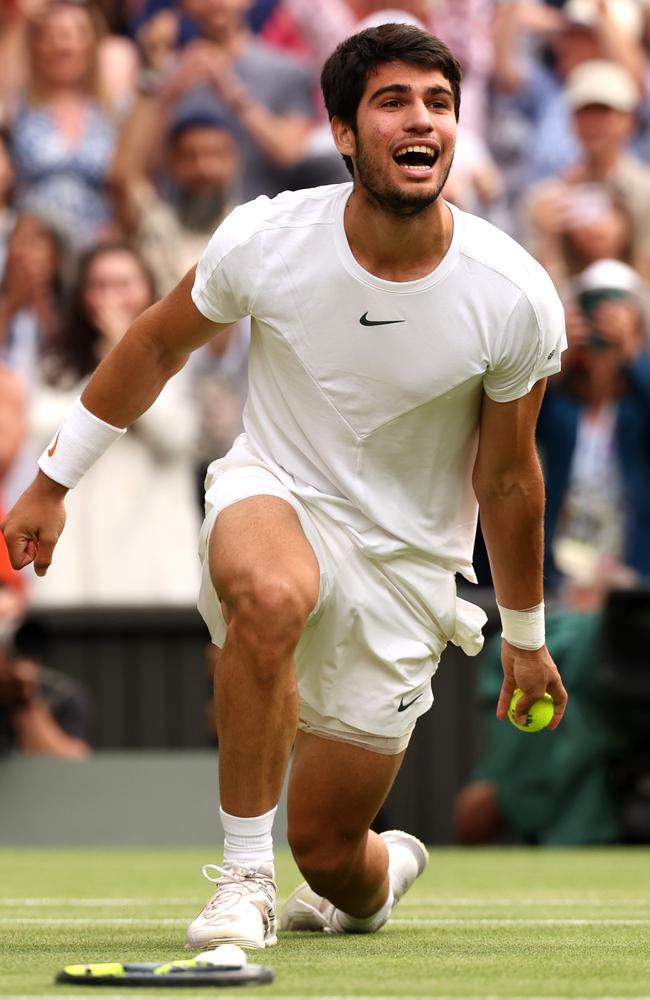
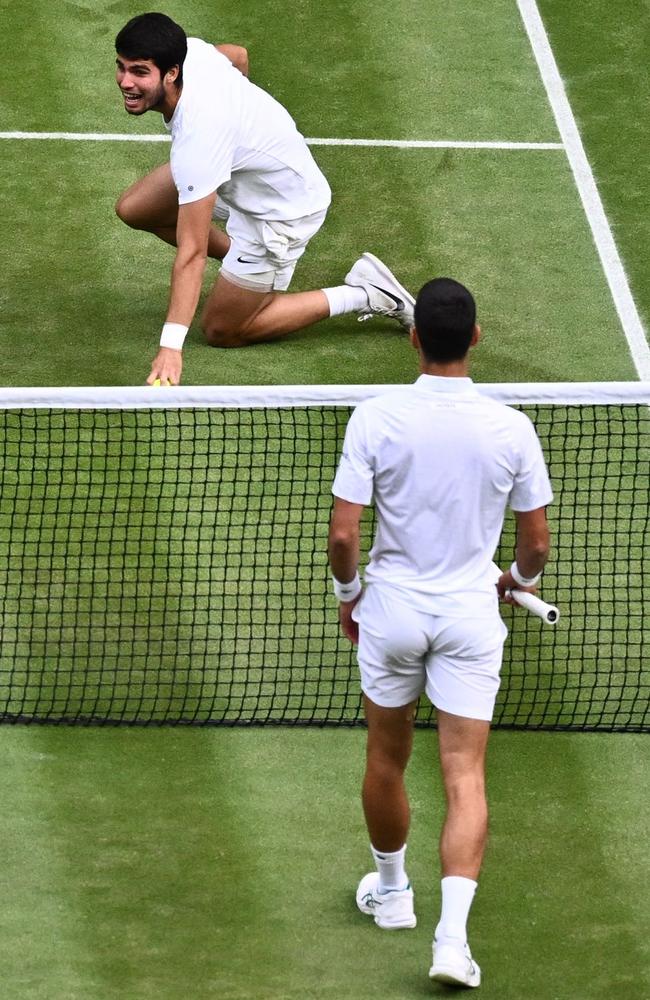
The thrust and parry continued for another handful of games before Alcaraz closed it out shortly after 6.50pm. As he sank to the grass in ecstasy, his coronation was complete.
“I did it for myself, not for the tennis generation, honestly. It was great,” he said.
“Beating Novak at his best, in this stage, (and) making history, while being the guy to beat him after 10 years unbeaten on that court, it is amazing for me. It’s something that I will never forget, that’s for sure.”

‘Very lonely mission’: The price of being a teen tennis star

Federer to return to Aus Open for ‘battle of the World No.1s’

Ultimate wildcard: Mystery still surrounds Kyrgios AO plans

Titmus sought out Barty for advice on early retirement

Demon’s vow after taking out top tennis honour for fourth time
