
Novak Djokovic won Wimbledon final by turning his back on Nick Kyrgios rather than engaging
It was a masterclass from Novak Djokovic in the Wimbledon final, with one smart tactic in particular making a huge difference against Nick Kyrgios, writes COURTNEY WALSH.

When it comes to masterclasses on a tennis court, Novak Djokovic has handed out hundreds.
The performance that drew him level with Pete Sampras as a seven-time Wimbledon champion on Sunday was a prime example.
The 21-time major winner eclipsed Nick Kyrgios with sustained concentration and the phenomenal array of tools he has at his disposal, including self-belief.
This was a lesson based on engagement. What he did between points was arguably as important as his efforts when the ball was in play.
Novak needed to be switched on throughout an exhilarating final to triumph, for little actually separated the combatants on a brilliant London day perfect for tennis.
Much will be made of Kyrgios’s composure late in the third set and how costly the lack of it proved in Djokovic’s 4-6 6-3 6-4 7-6 (3) victory.
Djokovic’s deliberate disengagement played a part in this. His pivot was on point. The moment Kyrgios blasted an ace past him, or when a significant rally expired, Djokovic turned his back on the court and his rival.
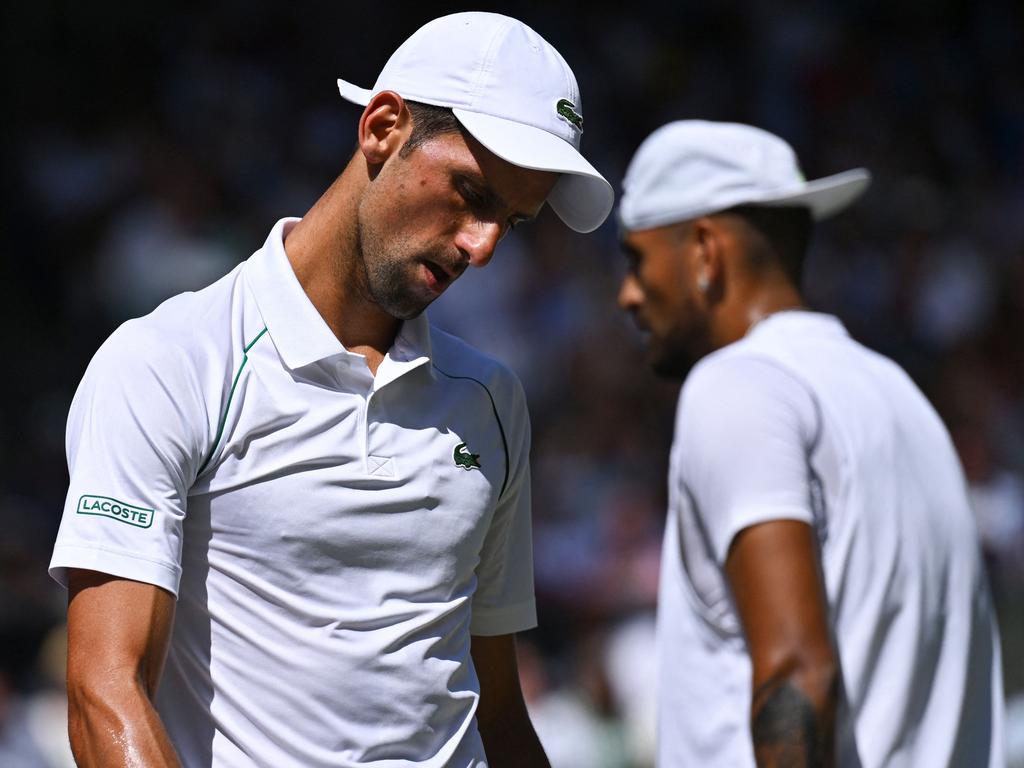
There were times where the Australian looked meaningfully towards the master, trying to catch his eye or gauge his emotions, after a stunning point.
By turning the other cheek and keeping his temper and emotions in check, Djokovic denied Kyrgios the ability to use his opponent as a motivating force.
Instead the 27-year-old turned to the crowd, singling out a catcaller he claimed had enjoyed 700 drinks, then the umpire and, most notably, his own support cast to release the tension he clearly felt leading into the implosion at 4-all, 40-0 in the third set.
Djokovic is not always the master of his own domain. The default at the US Open in 2020 is the most notable example of this. But he knows how to win matches and knew his best chance was to deny Kyrgios an emotional surge.
The 35-year-old’s tennis was superb. After being clobbered in their second round match, Thanasi Kokkinakis had no doubt Djokovic would defend his title.
Djokovic, who will slip to No.7 in the world as another farcical by-product of the decision to strip Wimbledon of ranking points this year, had moments where he was tested. The two who came closest were Jannik Sinner in a five set quarter-final and Kyrgios in the decider. But by and large, he was exceptional.
The quality of his serving and returning was incredible.
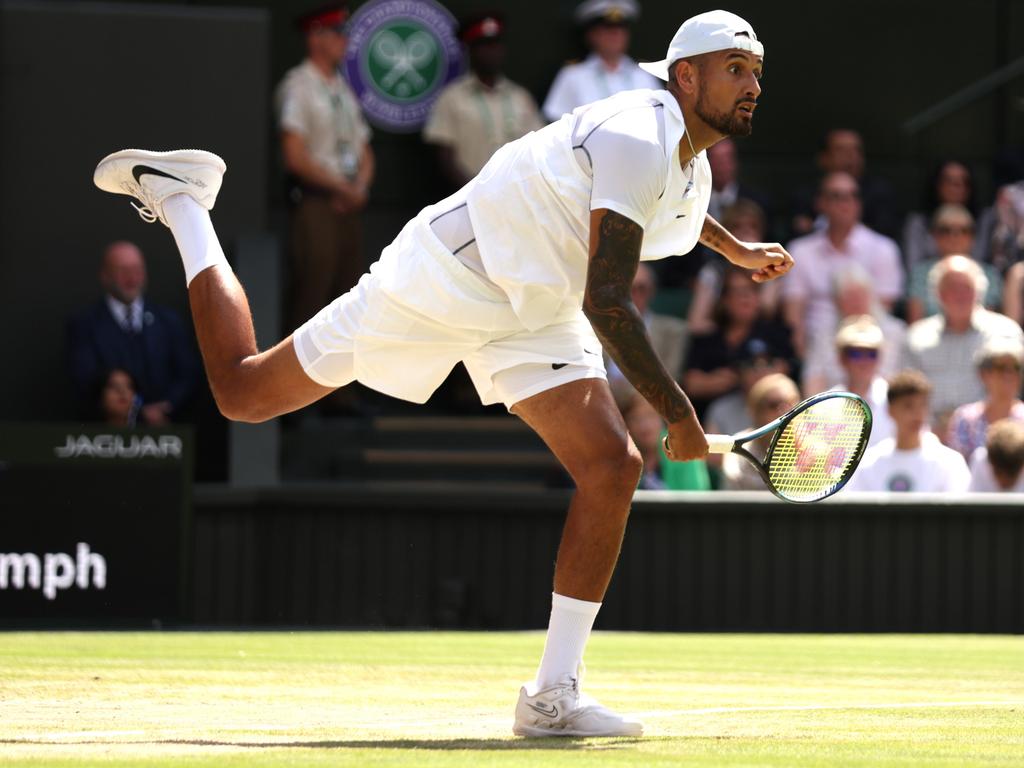
The Duke of Cambridge asked him after his triumph how he managed to return the Australian’s astonishing serve? Whatever the secret, the answer was evident. Bloody well. So well that dual Wimbledon doubles champion Paul McNamee noted something extraordinary late in the final: Novak had finally missed a return.
It took the opening set for him to read the Australian’s serve well enough to start putting pressure on Kyrgios but the longer the decider went, the deeper and more firmly struck the return was when he was able to get a racquet to it.
As well as Kyrgios – who struck 30 aces compared to his rival’s 15 – served, Djokovic still won more than one in every three points in the Australian’s service game. Kyrgios, in contrast, could manage only one-quarter.
The sustained excellence, described as “God” like by the beaten finalist, was another factor in Kyrgios cracking.
The nine-time Australian Open champion’s serve is underrated. It is not as powerful or precise as Kyrgios’, but its accuracy and the champion’s ability to hit the spots on critical moments is exceptional. So too his perception.

Kyrgios was within range of forcing a fifth set, having regrouped, when the superstar he was playing took a break at the end of the third set.
Djokovic made a couple of rare mistakes that offered half a chance, particularly at 30-all late in the fourth set when he missed a first serve.
A couple of games earlier, Kyrgios had moved eagerly forward and clipped a clean backhand winner on a second serve. It is the less explosive wing in rallies, but the technique is perfectly suited for that type of return.
So instead, with the Australian dancing forward in anticipation, Djokovic slid one to the forehand wing, where the swing is more exaggerated. It drew the frame of the racquet and flew wide. It was not a sure thing. But the master played the percentages perfectly.
Crisis averted.
He ended up winning 83 per cent of the points where he landed a first serve compared to Kyrgios’s 70 per cent, and had a similar advantage on the second serve as well.

Chief among other pivotal plays was Djokovic’s disguise on the backhand wing. His double-handed backhand is a beauty and arguably the world‘s best.
But he did the damage with his slice. It is not as stylish as Ash Barty or Roger Federer’s, for example, but it tends to be robotic in its reliability. What also makes it a weapon is that there is no tell when it comes to his drop shot.
As former world No.1 Andy Roddick noted, it is almost impossible to read. Kyrgios drew thunderous applause in the first set when, after a stunning rally, he ran down a drop shot to whip a forehand winner. But he barely won another one when brought forward in the court.
It was a tactic that helped swing the tide in the second set. And once the Serbian is settled in a match, it rarely ends well for a rival, especially at Wimbledon, where he has now won his last 28 matches.

‘Very lonely mission’: The price of being a teen tennis star

Federer to return to Aus Open for ‘battle of the World No.1s’

Ultimate wildcard: Mystery still surrounds Kyrgios AO plans

Titmus sought out Barty for advice on early retirement

Demon’s vow after taking out top tennis honour for fourth time
