
Box Hill icon David Banfield reflects on Hall of Fame honour, VFA battles, coaching alongside Tony Liberatore
David Banfield warmed the bench in the reserves before becoming a Box Hill great, captain, life member and now Hall of Famer. PAUL AMY discovers why the defender is so revered at the VFL club.

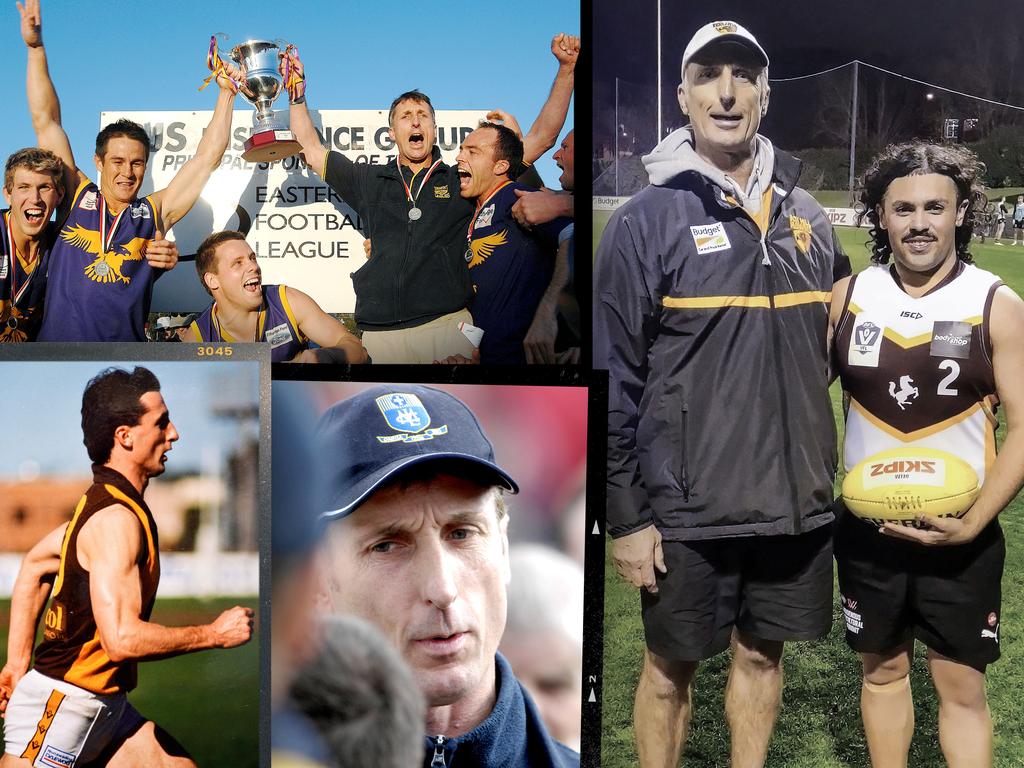
At the end of his first season at Box Hill, David Banfield sat down with coaches Harold Martin and Ian “Syd’’ Saunders to assess the year and his future as a VFA player.
It didn’t look promising.
Saunders, the reserves coach, was an old-school type and he told Banfield he was wearing the No.39 jumper because he was the 39th best player on the list.
“They didn’t beat around the bush,’’ Banfield says of the 1987 season review.
“Syd in particular made it pretty clear I wasn’t up to standard.
“I thought, yeah, I wasn’t given a great go. But I was young and I thought I could stay for another year and see where it took me.
“They were sitting on the fence. Syd looked straight at me and said, ‘You’re No.39 for a reason’. I didn’t fire back with anything but my brain immediately thought, ‘Who’s No.38?’ It was Don Growcott and I thought I was better than Don Growcott. And then I thought, ‘No.37, Dean Glare, I’m better than Dean Glare’. I was picking them all off.’’

From such a doubtful start sprang one of the most admired players in Box Hill’s history.
David Banfield became a leading VFA defender, a club best and fairest and captain.
In 1996 he was made a Box Hill life member. In 2000 he was named in the team of the century.
Now he’s been selected in its Hall of Fame.
His former teammate Darron Wilkinson, fellow past players Fred Bayes, Paul Bolton, Geoff Withers, Colin Love and Don Brown, long-serving official Lindsay Wilson, and stalwart sponsor and former director Paul Wheelton received the same honour.
When he was made skipper in 1994, the club asked Banfield if he wanted the No.1 jumper.
He declined, preferring to keep No.39 “to remind me of where I’d come from’’.

Legendary Box Hill administrator Johnny Ure penned a brief summary of Banfield’s career for the Hall of Fame booklet.
“Through fierce determination and willpower, he became a Box Hill champion, a miserly fullback who fought many memorable duels with the VFA’s goal kicking stars in a high scoring era,’’ Ure wrote.
That determination was evident after Saunders’ gloomy end-of-season appraisal.
That summer Banfield went off and did athletics at Nunawading, and when he returned to Box Hill, Martin was surprised at how different he looked.
He had grown to his full height of 189cm and he was fitter and stronger.
“I rocked up to the first night of pre-season and we did a time trial and I smashed it, because I’d been doing all this running,’’ he says.
“Harold’s eyes were popping out of his head. He goes, ‘You’ve been doing some work’. I’d gone back in good shape. From then on I jumped over 20 blokes. Trained hard and kept improving.’’
*****
Banfield played junior football at North Ringwood, which was in Essendon’s zone.
He had a year with the Bombers’ Under 19s under Ken Fletcher but wasn’t considered future senior material (his brother Peter did play league football for the Dons).

Going back to local football, he had an injury-tailed season with Blackburn, when the great VFA spearhead Peter “Fats’’ Neville was coach.
At the end of it, St Kilda came calling, and Banfield spent all the pre-season training under the great Darrel Baldock. He was one of the last players cut from the squad.
Banfield intended to go back to local ranks, but the Saints encouraged him to try the VFA.
He had a training run at Oakleigh but eventually went to Box Hill.
In his first season he often spent the first three quarters of games on the bench.
“I reckon that happened for eight weeks … I’d get on the ground at three-quarter time because Syd would say, ‘I’d better give you a run’.’’
He persisted, making his senior debut in 1988, only to be injured.
In his second game, he played on champion Preston spearhead Jamie “Spider’’ Shaw and conceded five goals in 25 minutes. Taken from the ground, he watched Shaw fill a bag of 13 goals.
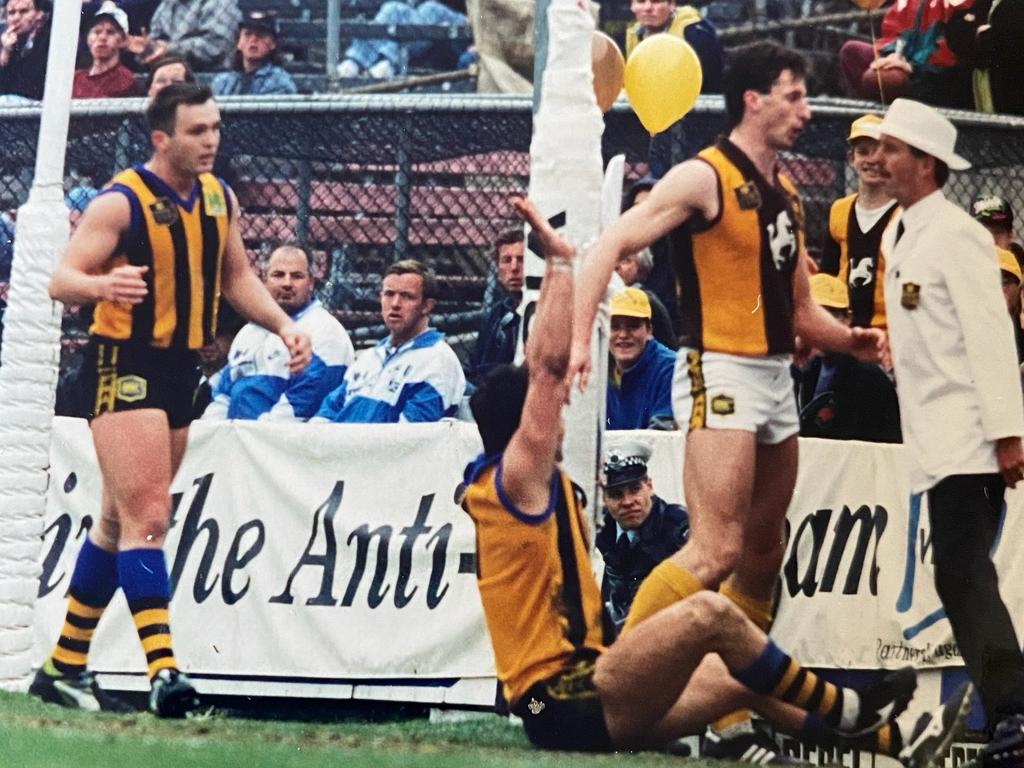
In future years Banfield played on forwards of the calibre of Rino Pretto, Ian “Chops’’ Rickman, the Gorozidis brothers and Joskun Aziz.
Former teammate Simon Dalrymple says it was a testing time for fullbacks; it was rare for other players to help as a third man up.
“You were on an island. You were isolated. But he was courageous and as honest as the day is long,’’ Dalrymple says.
“He reminds me of a Dale Morris, outstanding character, really good athlete, an awkward kick. You weren’t ever getting lace-out delivery but eventually the ball would get there because he’d win one-on-one contests.’’
In Banfield’s first year as captain he led the Mustangs into the grand final against Trevor Barker’s Sandringham, which flashed home to win by nine points.
By the time he retired after the 1997 season, he had played 137 senior games and won a best and fairest (1993).
Gary Woods and Jeff Shade, two of the players who used to warm the reserves interchange bench with Banfield, were astonished at his feats.
“They couldn’t believe it. They would often say it was amazing, one of those once-in-a-blue-moon stories,’’ Banfield says.
A 137-game veteran, captain, former assistant coach and now academy lead, David Banfield has done just about everything for his beloved Mustangs.
— Box Hill Hawks (@BoxHillHawks) September 23, 2021
This award recognises Box Hill Hawks Academy member to have shown the most growth and commitment both on and off-field. pic.twitter.com/KCLrgFOk5D
He counts making the Box Hill list as big an achievement as playing in VFA finals and captaining the club.
“I enjoyed being part of a team and leading a group,’’ Banfield says.
“But if you asked what was the highlight, I’d say it was singing the song. Loved it! I was over the top every time I did it. I’ve got two videos of me doing it and I’m going nuts. I often say to players now, ‘Sing it loud, boys’. That time at the end of a game when you’ve had some success and the team’s done well and you get to sing the song, that’s the happiest half-hour of the week.’’
Ure tells CODE Sports: “Out of all the Box Hill 100-game players, I’ve never seen a bloke work harder to make himself a top-notch footballer.
“It was an era for full-forwards and ‘Banners’ had great battles with all of them.’’
He recalls a final at Port Melbourne, when Rickman kicked six goals in the first half for Williamstown, but Banfield kept him goalless in the second half.
“It was a fantastic performance. He just wouldn’t be defeated,’’ Ure says.

“He was dour, very defensive. I can remember a game when we played Coburg at the City Oval. I can’t remember who the full-forward was, but his stats for the day were one kick and one behind. ‘Banners’ stood six inches away from him all day and I reckon the poor bloke had nightmares for the next two weeks waking up to find ‘Banners’ in bed next to him!’’
Banfield, he says, was a vocal captain, like a “shop steward’’ in taking up matters forcefully with the board on behalf of the players.
It was unusual but showed his passion and care for his team.
*****
After his playing career ended, Banfield went coaching in the Eastern league, first as an assistant at East Ringwood.
His start as a senior coach came at Doncaster, where he spent two years, and then Croydon, where he was sacked after one season (he thought of himself as a “hardworking coach with an ordinary list, and I got shafted’’).
“Not dissimilar to my playing, it didn’t start out smoothly for me,’’ he says.
He made up for it, flag by flag.
From Croydon he went back to Box Hill, where he helped Donald McDonald and then Tony Liberatore.
Hanging around McDonald was good, he says. And hanging around “Libba’’ was great.
“He was fanatical in the box and at training. He was just what I needed. After that year with him, I was absolutely cherry-ripe to go and coach again,’’ Banfield says.
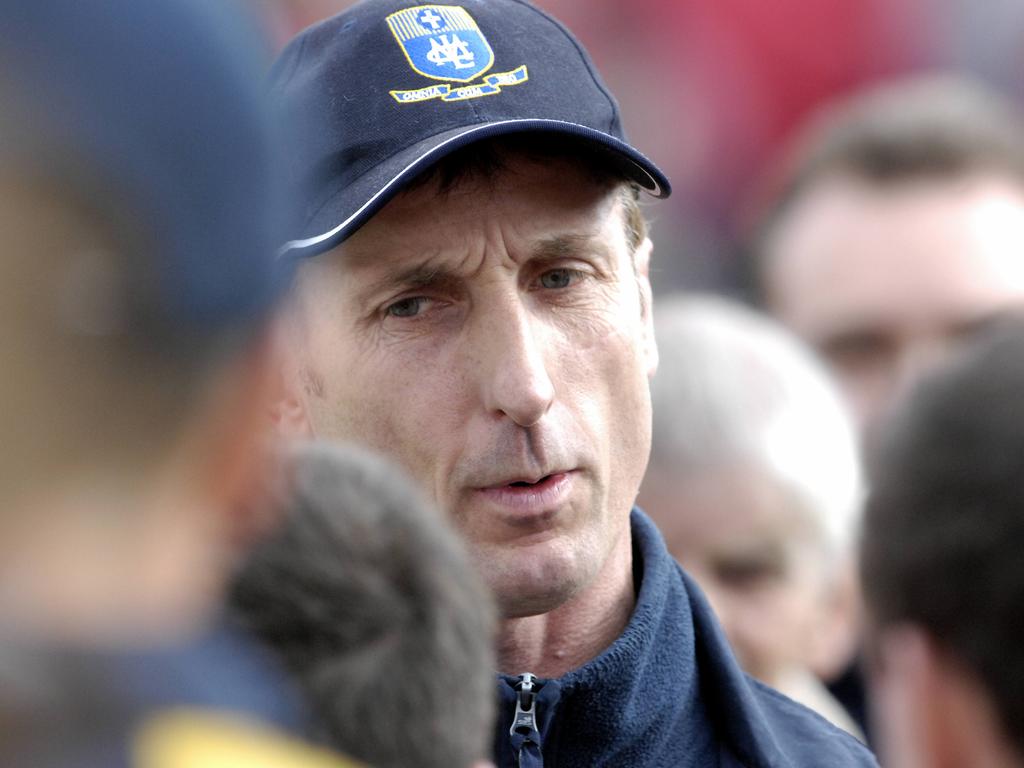
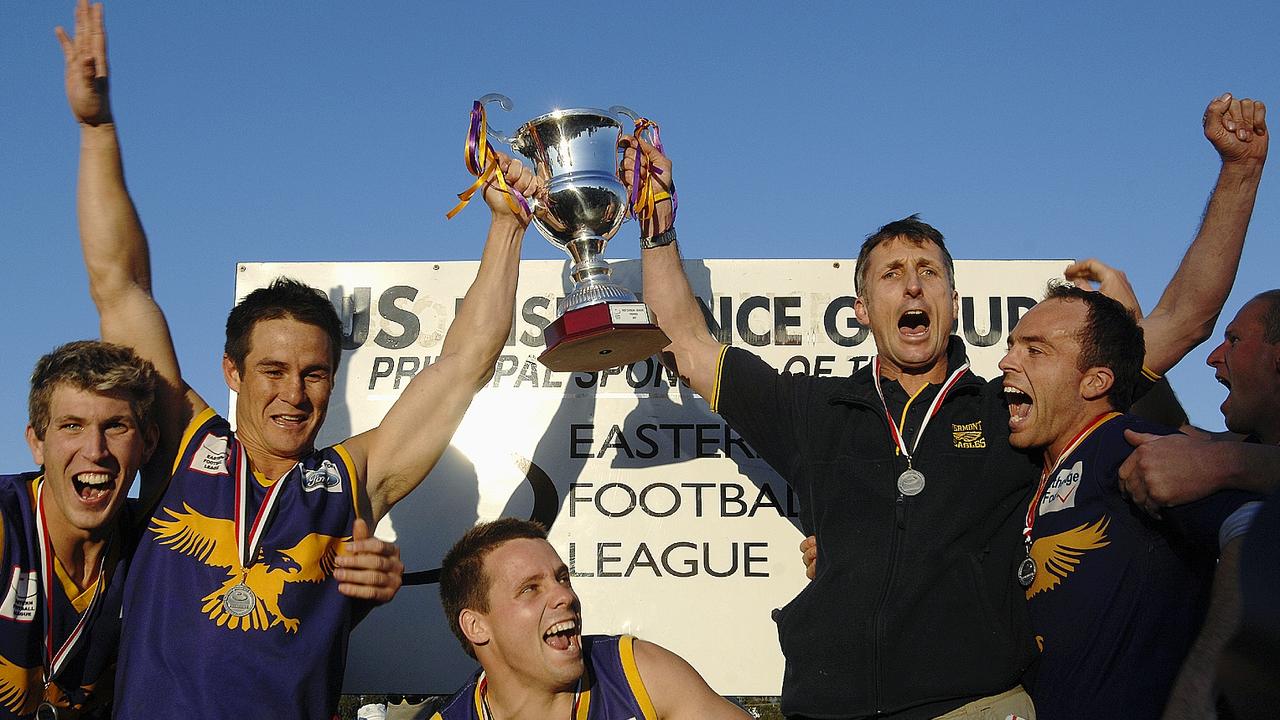
He landed the senior position at Vermont. And across eight seasons he steered the Eagles to the 2005, 2006, 2007 and 2009 premierships.
They had some of the finest players seen in the Eastern league in the past 25 years – including Matt Greig, Bernard Dinneen, Ryan Mullett, Ash Froud, Brad and Marc Cullen, and Kris Bardon – and Banfield gave them their heads.
“The man-management stuff, being a little older and wiser in my coaching journey, I didn’t need to butt heads with them,’’ Banfield says.
“I always coached from the box, because I was a tactical coach, not a man-manager. Adam Parker likes to be trackside and talk to players as they come off, Steve Cochrane likes to be on the ground and AFL coaches nowadays ebb and flow between both, upstairs tactics, downstairs management. I didn’t think the players needed me grabbing them every time they came off the ground telling them how they needed to do it. They played their best footy whenever it was set up for them to just play. So it worked.’’
He says the support at Vermont was fantastic; he was often asked by president Rod Dux and general manager Lee Bidstrup, “What do you need, how can I help?’’
Banfield believes he was “at the right club at the right time’’.
“The things I learned from ‘Libba’, I took to the EFNL and I was ahead of the curve for quite a few years,’’ he says.
“Things changed. The advantage lessened over time. But we made hay while the sun shone.’’
Dinneen, back at Vermont doing football operations, has a different perspective of Banfield the coach.
He believes he was a superior manager of people than a tactician.
Dinneen had played under Tony Paatsch and Simon Dalrymple at Marcellin in the amateurs and he thought they were outstanding coaches.
“I went there (Vermont) expecting high standards,’’ he says.
“I worked with ‘Banners’ as an assistant coach for two years and I was pretty strong-minded and clear on how I thought it should be done. At times I remembered thinking guys were probably getting a bit of a leave pass and he didn’t set the standards and expectations as high as I would have liked.
“It’s only on reflection, after you do more playing and coaching yourself, that I realise his biggest strength was that he was a good manager of people. We knew he was a good motivator. But we had a super-talented list, which obviously makes it easier, and I think ‘Banners’ was the right person for our group at that time.
“We had a good mix of experienced older heads, we had some kids coming through, we had some good leaders. He made the right person captain in Brad Cullen to bring it together. He meshed the group.

“He was an amazing manager and in that sense in the professional sporting world you’d compare him to Alex Ferguson, strong values, strong ethics and he managed people really well.’’
Banfield stepped down at the end of 2011, after missing the finals two years running.
He remembers telling Mullett: “I’m not sticking around here so that your footy career keeps ticking along and you’re not getting the opportunity to play finals’’.
Former Hawthorn forward Kris Barlow replaced him, and Vermont made the 2012 grand final.
Banfield thought he made the right decision for a club where he’d had so much success and support.
Bidstrup says Banfield was something of a quirky character, but unfailingly positive and organised.
He remembers rainy training nights when the coach would be moving cones and roaring, “Where would you rather be?’’ (At home, Bidstrup would reply).
Bidstrup says the younger players Banfield developed were just as important to the premierships as high-profile recruits.
“His sincerity and his passion were catchy. Players would very much feel that,’’ he says.
They still see a bit of Banfield at Terrara Rd: his son Harry is now playing for the senior team.
*****
After resigning as coach of Vermont, Banfield returned, again, to Box Hill, and he’s been there since as an assistant coach and head of the academy, contributing to two senior premierships and one in the Development League.
He was delighted when Ure gave him the news that he’d been added to the club’s hall of fame.
But he was bemused too.
“My honest response was, ‘You should have given it to someone else, because I’m still here’.
“I haven’t finished and I feel like I’m going to be here for a while to come. As far as I’m concerned, I’m still going.’’
David Banfield’s standout footballers
VFA
Terry Wheeler (playing coach of Williamstown)
At a home game at the start of 1987, we were a couple of goals down at three-quarter time kicking with a strong breeze. I listened to Harold Martin give a great speech that finished with, “Let’s do it for the Mustangs’’. I then raced over to the Willy huddle. Terry finished looking at his magnet board, turned to the players and said something like, “It’s a strong breeze and you know what you‘ve got to do’’. I thought to myself, “We will kill them’’. I was wrong; they kicked five goals and won convincingly and it gave me a new appreciation of the art of coaching.

Tim Rienets (Coburg)
The Burgers were a dominant team in the late 1980s with match winners everywhere. Phil Cleary had them playing so well that they won back-to-back flags. Tim was a standout with his ball use and decision-making, and it was no surprise he made his way on to an AFL list.
Jamie “Spider’’ Shaw (Preston)
He managed to take marks whether you played him from the front, from the back or side shoulder. The Preston on-ballers would be 40m out and would choose to pass it to him rather than take a shot. The red boots and tattoos were intimidating in those days and the nickname “Spider’’ completed the picture. I never enjoyed the drive to Cramer St.
VERMONT
Cameron Dore
Cameron has gone on to become a very successful AFL umpire. He shared his wing rotation in 2009 with the superstars Aaron Nummy and Nathan Henley. He knew his role was to come off the bench and allow them to freshen up and he always played the defensive wing so that they could go out and attack. He is the best example I have of a “champion team will always beat a team of champions’’.

Daniel Papillo
More Coverage


I had been involved with a lot of good teams without winning a flag when I arrived at Vermont. It definitely bothered me and the flag in 2005 at Vermont was a huge relief. On a wet and windy day at Bayswater we were in a huge arm wrestle with Donvale, which led at half time. Our only goal in the second half was kicked by fullback Grant McCarthy. A standout memory was a moment of courage and bravery shown by Daniel Papillo late in the game. He held his nerve and his ground as a wall of players crashed into him, won a free kick and stopped what looked like a certain goal for Donvale. Soon after that we were singing the song.
Matt Greig
I have been asked a few times to name my best-ever Vermont team or best players and have always refused. I would not want to leave anyone out. To keep it simple though, Matt Greig would be No 1. He was everything I wasn‘t as a footballer. He was laid back at training, not strict with his diet, not too fussed with meetings and had skills that I could only dream of. He was the Eagle who flew above the pack time and again and we all soared with him as he spread his wings.

How Tassie stadium greenlight is a win for the NT’s AFL team push

NTFA: Every clubs’ recruits, re-signings for 2026

New Bombers coach targets youth-led ‘reset’ after player exits

Top End footy battles wild weather following Tasmania’s stadium debate

90+ names: The greatest players in QAFL history
