
Inside America’s seismic sports streaming shift, from WWE on Netflix to conglomerates, and what it means for Australia
Netflix paid $5 billion for the WWE’s top show. Three giants changed the game by teaming up. What is going on in US sports streaming? SHANNON GILL talks to a revolutionary figure about the huge implications.

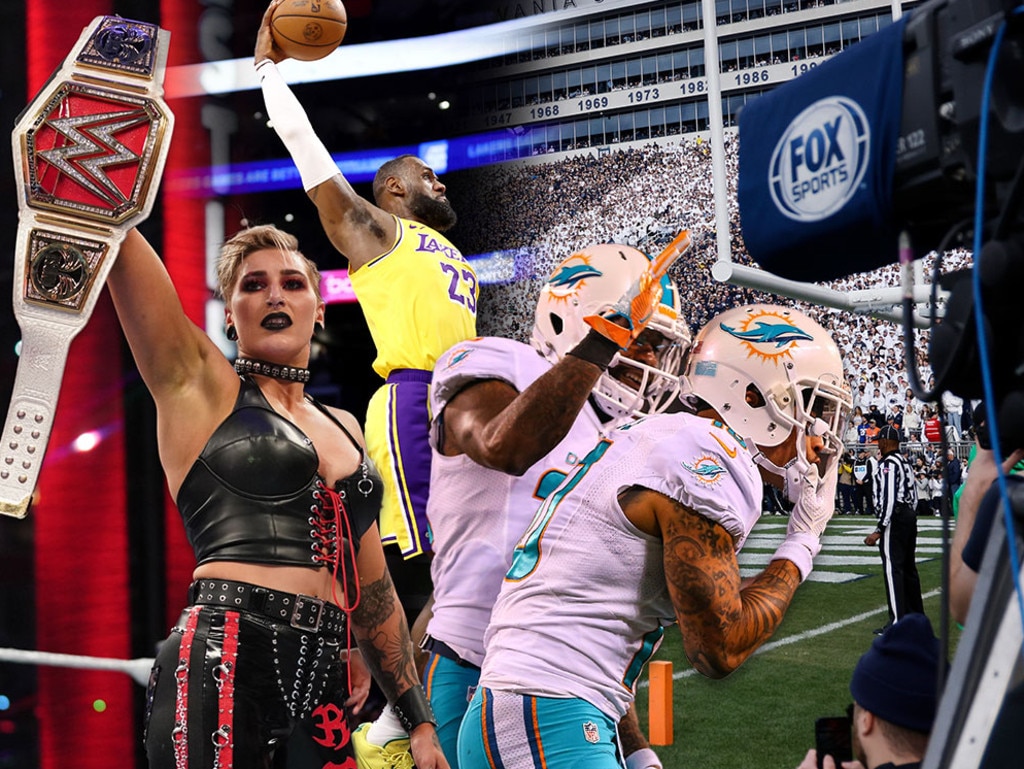
Less than two months into 2024, it is already shaping as the year that global sport goes all-in on streaming.
The announcement of an imminent US sports-only streaming platform involving Fox, ESPN and Warner Brothers may be the most obvious example, but just weeks before there was another seismic announcement.
When the WWE sealed a 10-year, $5 billion deal with Netflix for it to become the US home of flagship weekly prime-time television product Monday Night Raw from 2026, it was the first time that the world’s biggest streaming company had signed up a major sport for live broadcast. As it stands, WWE’s home in Australia remains Foxtel and Binge.
To give Australian context, the WWE move would be like the AFL or NRL carving off its premium television product, Friday night football, and selling it to a streaming-only platform.
The predictable argument against this having meaning for other sports is that ‘wrestling isn’t a real sport’.
Yet Eric Bischoff, who helped revolutionise pro wrestling on TV in the 1990s with his upstart WCW and has analysed US sports on television for decades, says that where wrestling goes, mainstream sport tends to follow.

“Professional wrestling is looked at as kind of the innovator in sports,” Bischoff tells CODE Sports.
“In the beginning of television time when not every family in the United States owned a television, one of the most successful programs on that network was professional wrestling.
“Then you went to cable television and still to this day, one of the most popular forms of entertainment there remains professional wrestling. Out of cable television comes pay per view; what was one of the most consistent performers of pay per view? Professional wrestling.
“Then fast-forward a decade, they decided to abandon traditional pay per view, which was at least responsible for 25-30 per cent of total revenue, for their own ‘over the top network’; the wwe.com streaming platform.
“And here we are today talking about a $5 billion deal on Netflix that has completely changed the landscape. Now people are going, ‘Hey, if WWE is doing it on the streaming platform, maybe that’s the direction of sports’.”
*****
While not yet diving all-in like the WWE, the US’ biggest sporting league, the NFL, is in the streaming waters too.
Amazon Prime became the exclusive rights holder for 16 Thursday night football games in 2023, and while that slot is still the lesser real estate in the NFL rights mix, it represented the first time the league had given exclusivity to a streamer.
That trend continued when streamer Peacock paid a reported $110 million for exclusive rights to a single NFL wildcard playoff game between Miami and Kansas City this season.

With traditional network television still needing live sport to remain relevant and the biggest streamer of them all (Netflix has more than 260 million subscribers worldwide and recorded a 13 per cent increase in 2023) spending $5 billion on ‘sports entertainment’, the US rights market is being tipped for a shake-up.
Fox, ESPN and Warner announcing their sports-only streaming service only confirms that streamers will play a pivotal role in every US sports rights negotiation in the coming years. By bundling many sports together it also works against the streaming fragmentation that many have been frustrated by.
The initial test will be the NBA rights deal that expires at the end of the 2024-25 season.
The window for exclusive renegotiations by incumbents, Disney’s ESPN/ABC and Warner Discovery’s TNT, expires in April and it’s expected that streamers like the new conglomerate and perhaps Netflix will join the bidding.
Currently, the NBA receives $2.6 billion per year; some are expecting it to double or triple with the increased competition.
Again, the guide is there with the WWE Raw deal.
The $500 million per year it will earn with Netflix effectively doubles the current $250 million per year deal with NBC’s basic cable USA Network.

*****
What does this all mean for Australia?
Our sneak peek of the sports streaming world has largely come via Kayo Sports, which is a complete and broadened offering of Foxtels’s pay TV sports package on a streaming service; a sort of Netflix of sports. Content-wise, it is a prototype version of what the US Fox/ESPN/Warner Brothers joint enterprise threatens to be.
That sports streaming is now a habit could point to a similar shake-up of Australian rights deals like is expected in the US, with new streamers competing with the existing players. The difference is that unlike the US, we have anti-siphoning legislation protecting free-to-air sports broadcasts.
Currently Australian laws do not adequately cover streaming-only services; so in theory, Netflix could come in and purchase rights to ‘nationally important and cultural significant events’ that were on the anti-siphoning list, protected from the paywall of pay TV.
A version of this happened last year when streamer Optus Sport purchased exclusive Australian broadcast rights to the FIFA Women’s World Cup. It then sublicensed 15 games (including Matildas matches) to free-to-air broadcaster Seven through a tender process.
Triggered by this (and that Australian Women’s World Cup matches were not on the anti-siphoning list), in November the Federal Government introduced the Communications Legislation Amendment (Prominence and Anti-siphoning) bill to modernise the legislation and effectively see subscription streaming services treated the same as pay TV providers in being fenced off from events on the list.
This would stop Australian sport from conducting unfettered exclusive rights auctions for those events involving streamers like what is imminent in the US.
The bill is yet to be passed and has been referred to the Environment and Communications Legislation Committee for inquiry and report by 26 March this year. Philosophically it is a test of whether the government trusts sport to act within the best interests of public appeal and participation, as well as the balance sheet. Submissions have been made from all the major players.

The Coalition of Major Professional and Participation Sports submission – on behalf of major sporting bodies the NRL, AFL, Football Australia, Cricket Australia, Netball Australia and Tennis Australia – contends that ‘as the governing bodies of our respective sports, we are best placed to determine how our respective media rights are licensed (without the need for Government intervention).’
Supporters of this view point to the Women’s World Cup, where sports and streamers worked to ensure appropriate access despite the law not compelling them to. Reach was ultimately balanced without driving down rights value.
The submission was made public earlier this month and makes it clear the sports would prefer no anti-siphoning list. But if it had to live with one, it needs to be modernised to give more flexibility to exploit rights value.
Nobody is holding their breath in thinking government will take any steps to create a streaming free-for-all, but times are changing.
In the US, pay TV households have dropped from around 100 million in 2016 to 68.5 million in 2022. Now, more than 113 million US households have access to at least one streaming device, accounting for 87 per cent of the American population.
Finder Research last year found that Australia is also trending that way. Sixty-nine per cent of Australians use at least one streaming device and the average Aussie uses two.
Kayo subscriptions have grown by 4% year on year and now total 1.183 million ahead of its biggest acquisition period, the NRL and AFL seasons.
The signs are that Australians have embraced paying for streamed sport.

Combined with overall streaming number reach, this at least questions the historical view that putting major sport behind a paywall will drastically reduce viewers and public interest in the trade for cash.
Bischoff thinks that the opposite will occur with WWE’s Netflix deal in the US.
“I think the existing US subscriber base of Netflix is so significant that WWE is going to experience greater viewership just by association,” he says.
“Existing WWE fans who are not part of Netflix are going to be very soon. So I can’t imagine a scenario where there is anything but growth in the audience as a result of this.”
In Bischoff’s view, this points to a broader trend about how we consume television. If sports are not making major streamers a primary delivery point, will they be left behind?
More Coverage


“How much more engagement are we going to get because it’s just easier to watch on your tablet or your phone or in your office?” he asks.
“How many more eyeballs are we going to attract on streaming simply because it’s a preferred way to consume? The writing is on the wall, there’s already conversations here in the US that the NFL will eventually go to exclusive streaming of the Super Bowl, which would be just an amazing departure, but I think that’s where things are going.
“Traditional television is going to be much like an eight track tape. People will remember it, some people may still have it, but very few people will use it.”

WWE fans fume as John Cena’s career ends with ultimate irony

Named: The stars of the Australian Volleyball Schools Cup

Inside the innovative public school that churns out elite athletes

Big futures: Who are the Aussie U18 Rugby Sevens golden studs?

100+ photos: The best local sport action
