
Rugby League Digest’s mission to get to the core of the Super League War
As Michael Adams and Andrew Paskin began their years-long odyssey of podcasting the drama of the Super League War, they realised there’s much more to it than pay TV, writes BRENDAN BRADFORD.

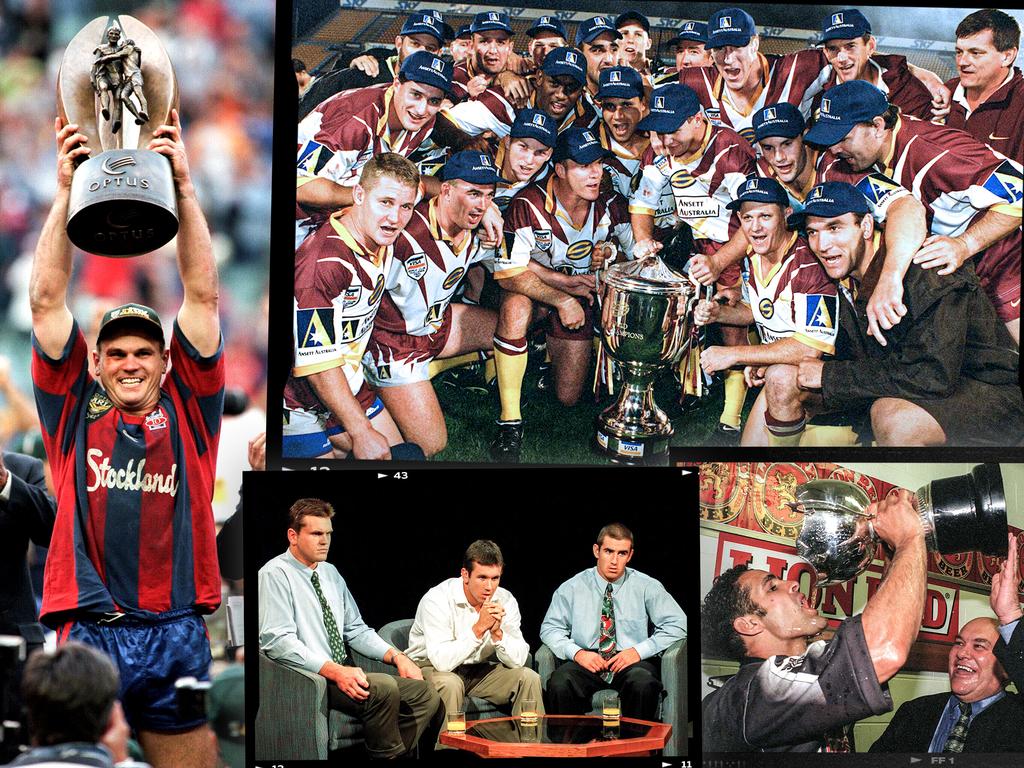
It was late 2017 and mates Michael Adams and Andrew Paskin had just wrapped another episode of their weekly podcast.
It was a comedy podcast which featured rugby league heavily, with a bit of the game’s history sprinkled throughout.
But after a couple of years of following the news cycle, they both felt it was time to move on.
As the season wound down, Adams and Paskin wrote up a shortlist of topics they thought would be interesting to investigate and discuss for a new series.
There was the best of rugby league in the 1990s, the birth of the Melbourne Storm, the Winfield Cup era and many, many others.
It wasn’t long before they realised that each of those topics had one common theme running through them.
“We had this list of all these history topics, but every topic, at some point, involved Super League,” says Adams.
“It just became expedient where we were going to have to talk about Super League to talk about any of these other things.”
We are off! Season three of The Super League War begins with Chapter 32: Clearing the Decks, now available exclusively on Patreon. Available on all other platforms Wednesdayhttps://t.co/aJI5ZIlPHn
— Rugby League Digest (@leaguedigest) August 22, 2022
That’s how their years-long odyssey into researching every minute detail of the Super League War began.
It took another year or so to get up and running, but after three years, almost 100 episodes and millions (literally millions) of words of research, Adams and Paskin are preparing to launch the third season of their hugely successful and influential podcast this week.
This is the untold story of the Rugby League Digest’s in-depth investigation into the Super League War.
*****
Adams and Paskin weren’t just drawn to the Super League War because of the way it shaped the game. It was the fact that in the two and a half decades since the 1997 Super League season, no one had ever truly investigated and discussed what actually happened.
For those still involved in the game, there was never really an appetite for it. Old wounds had only just healed, but the many broken friendships never did. This is rugby league after all.
It was a situation they felt they could address.
“It was just so weird to both of us that for a story that had such a massive impact on the game, there was hardly any coverage on it,” Adams says.
“The fans of rugby league still talked about it and still held grudges, but there just seemed to be this impetus from the media to try and memory-hole Super League.”

These aren’t top-line, generalised discussions either. The Rugby League Digest Podcast goes deep.
Most episodes are about an hour-long and involve an investigation and discussion around a particular event, season, team or figure. There’s an episode dedicated to Paul Harragon hiring a minibus and driving his Newcastle teammates to Sydney to speak with the ARL. There’s one on the plight of the 1990s iteration of the Gold Coast and another on Bulldogs icon Peter ‘Bullfrog’ Moore.
Other episodes delve into the Hillsborough disaster and the state of rugby union at the time. Neither of them are about league, but they give a much-needed framework to view the events of the Super League War.
In a crowded podcast market, theirs stands out for its depth of knowledge and reasoned debate. It’s not just a couple of blokes sitting around talking about the weekend’s results and the outcome of their first tryscorer bets. It was something more.
“Andy and I both like to think we’re reasonably intelligent, and I just found that there was nothing really out there for me,” Adams says.
“We found that, simultaneously, there was no one taking the game seriously, and there was no one really capturing the unique absurdity and ridiculousness of rugby league. So that was our brief at the outset and in Andy, I don’t think there’s anyone who innately understands that more.”
Paskin – who formulates questions for game shows, writes jokes for TV, was formerly a criminal lawyer and does stand-up comedy himself – adds: “It’s the funniest people in the world, but it’s also quaint.
“It’s tough, real men.
“It’s also imbeciles. It’s the best of humanity.”

That mix of the serious and the absurd still underpins much of the game today.
“We love rugby league men for all those failings and all those strengths,” Adams says.
“It’s been a big part of our lives, and we do have a passion and respect for the sheer ridiculousness of it all.”
Adams and Paskin also strike the perfect balance.
A historian, Adams does the research (more on that shortly), while Paskin’s wit and sheer knowledge of rugby league and Australia in the ‘90s allows the conversation to flow. Their ability to give events from 25 years ago context and meaning in a broader cultural and historical sense is crucial to its success.
They’re also reflective enough to weed out the many layers of rugby league bullshit and extract pure comedy out of one of the tensest periods in the game’s history.
“There’s a never-ending supply of hilarity in rugby league,” Paskin says.
“But, Michael was irritated at the imbecile fan, which I represent, who was just going, ‘It’s all about pay TV, mate’, and thinking that was it, like there was nothing more to it.”
Adams adds: “Yeah, so, we thought we’d do 150 hours of audio to then come up with the conclusion that it’s all about pay TV.”
Which brings us to one of the most important elements of the podcast. Adams and Paskin aren’t trying to convert nonbelievers, sell a particular version of events or rewrite history.
From the point of view of a couple of outsiders, they lay out all the details, and allow the listener to make up their own minds.
Going into the project, Adams, a Dragons fan, was more aligned with the ARL, while Raiders diehard Paskin fell on the Super League side of the war.
Like many listeners, they’ve both softened those stances now.
“I think everybody that listens this long into it has now got a more nuanced view,” Paskin says.
“It just seemed so cut and dried at the time, but looking into it, it’s like, ‘My God, they all made so many mistakes’.”

*****
It’s not a stretch to say Adams has probably read more about the Super League era than anyone else on the planet.
As part of his research, he has scoured the archives for every single newspaper article on that tumultuous few seasons in rugby league.
He has read every issue of Rugby League Week and Big League. Those back issues aren’t digitised either, so he took photos of every page, saved them as PDFs, highlighted relevant sections and saved them in various Excel spreadsheets for future reference.
“Like a Soviet spy with his little camera and microfilms,” Paskin laughs.
Adams has also read every biography, autobiography and history book from the era.
The pick of the bunch, he says, is Matthew Ridge’s blunt and unintentionally hilarious Take No Prisoner.
Rugby league biographies will often bore you to tears because players don’t want to offend anyone.
Not Ridge. The former Manly and Warriors star perfectly encapsulates the seriousness and the absurdity that defined the time.
“It’s one of the greatest documents of the rugby league mentality,” Adams laughs.
“It’s such an important piece of literature. It’s astounding how well it captures the rugby league voice, and Matthew Ridge’s voice in particular. It’s just so personal and genuine, it stands alone in the pantheon.”
“It captures the mentality of the rugby league player,” Paskin adds.
“It’s entitlement, funniness and being a character, but not knowing it.”
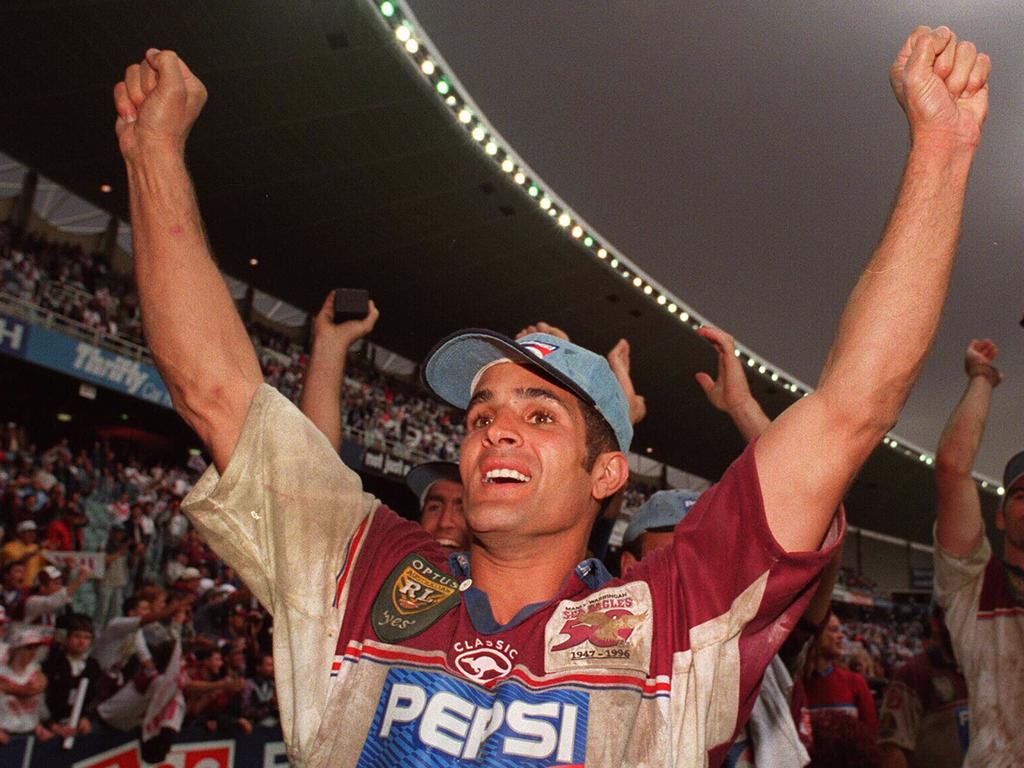
In addition to the books, Adams has devoured journal articles, court transcripts and legal rulings.
Once he has collected all the info he needs, he starts writing up lengthy dossiers, which he sends to Paskin, who adds, refines and comments.
It’s a process that takes months.
Only after it’s done are they ready to record.
“I’ve got a full time job and two kids,” Adams says.
“If someone had sat me down and told me how much work would be involved, and explained what my life would look like for the next four years, I probably would’ve said, ‘OK, I can’t do that’.”
The dedicated community of listeners and Patreon supporters they’ve generated is glad no one told him beforehand.
It’s a following that grew organically via word of mouth and social media.
“That’s the best thing about it – there’s no advertising or anything because it is such a niche audience,” Paskin says.
“Someone will tell their dad, or other people will find it on YouTube because they can’t figure podcasts out.”
Cooking up some Super League… pic.twitter.com/KOBsh3NhpH
— Rugby League Digest (@leaguedigest) August 14, 2022
The bulk of the RLD listenership, says Adams, are middle aged men revisiting that period of the game, but they’ve also attracted a huge fanbase of younger listeners learning about the War in depth for the first time.
When Covid hit, they even picked up fans from overseas.
“It’s such an American story in many ways when you think of the industrial relations in sport over there, so there’s a lot of parallels,” says Adams.
“We’ve got quite a few American listeners reach out during the first Covid lockdowns when there was no sport on saying they’d discovered rugby league.
“A few of them made their way to our show, which was a really cool thing to happen.”
The response from the online community has been overwhelmingly positive, but there was one letter of warning that made Adams and Paskin take notice.
The letter came from a figure very high up in the legal fraternity who had a family member involved in rugby league administration prior to the Super League War.
In the strongly worded missive, the legal man urged Rugby League Digest to minimise the role his relative played in the game at the time.
“It was very intimidating, but also, it was pretty cool – he’s listened to the show,” Adams says now.
“After some back and forth and an erratum, we managed to come to a common understanding and he had some nice words for us at the end, so that was pretty cool.”

*****
Season three officially launches this week, and, finally, they’ll be talking about the 1997 Super League season.
“We had a recording session a week ago and we were both just like, ‘I can’t believe we’re actually talking about Super League as a concept,” Adams laughs.
“It’s just been an abstract concept for the last three or four years.
“It’s a really fun season, because most of the drama has already happened and it’s really about the rugby league side of things a bit more.
“It’s almost like a season-long recap, which will obviously have a lot of intrigue in terms of the eventual reunification of the game.
“But there’s some really fun stories coming up.”

Lomax’s surprise code switch: Ex-Eels star takes up cricket

Cleary’s Panthers return locked in after Europe getaway with Fowler

‘Strange welcoming’: Brown’s unusual start to Newcastle life

NRL journeymen, sons of guns: Every club’s train and trial players

Pezet on deck as 150 Eels players gather for whole club hitout
