
Origin legends back radical eligibility change that opens door to English, Kiwi, Samoan and Tongan players
Paul Gallen and Justin Hodges have called for a State of Origin revamp that would open the door to English, Kiwi, Samoan and Tongan players, writes BRENDAN BRADFORD.

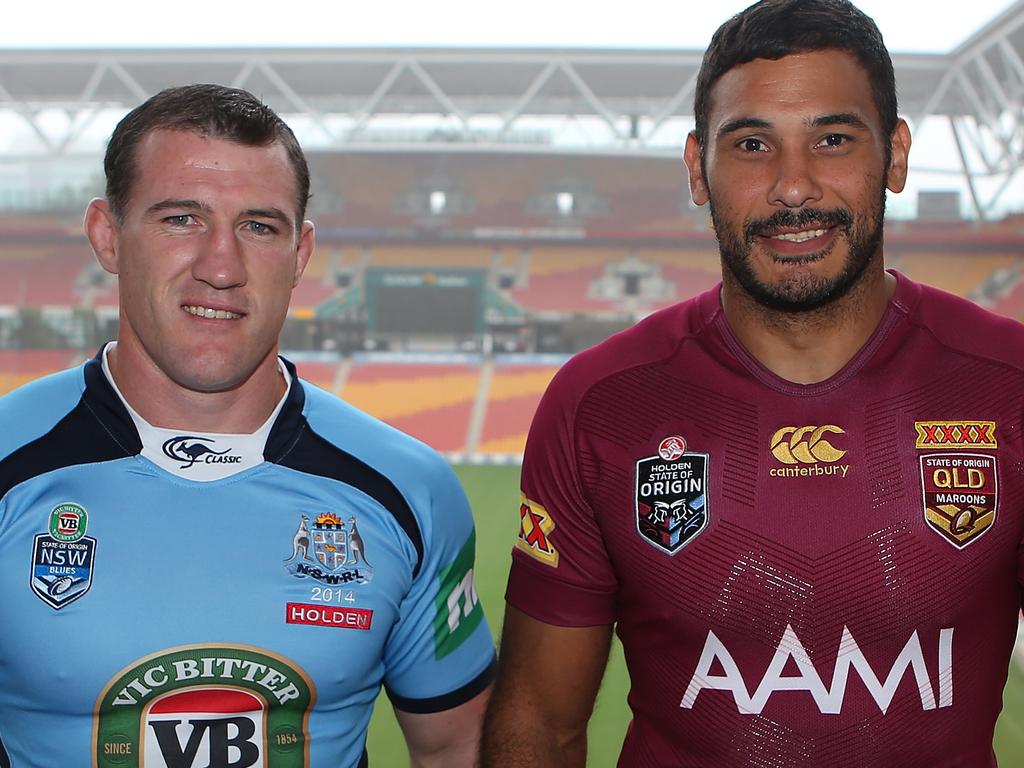
Former NSW captain Paul Gallen says international rugby league must ditch the tiered classification system – even if it means Kiwis and Englishmen playing State of Origin.
Under the current rules, any player representing another tier one nation is unable to play Origin, ruling out England and New Zealand internationals.
The International Rugby League will address Samoa and Tonga’s status after the World Cup, and the governing body is said to be considering elevating one, if not both countries from tier two to tier one.
Importantly, on-field performances don’t dictate which tier a country is classified as, with local competitions and junior pathways both key factors as well.
Under the NRL’s current Origin eligibility rules, if Samoa is elevated to tier one status, players like Junior Paulo, Jarome Luai, Brian To’o and Stephen Crichton will be forced to choose between NSW and Samoa.

Gallen, who captained NSW on 15 occasions, says it’s time for the game to adjust.
“Get rid of the tier one and two crap,” Gallen told CODE Sports.
“At the start of your career, you nominate whether you’re a New South Welshman or a Queenslander, and you choose what country you want to play for (at the same time).
“The reason it’s called tier one and two is because it comes down to the local competitions in your country – it doesn’t matter how good your team is.
“That’s the problem, because look at Samoa, they’ve just made the World Cup final.
“I think let’s get rid of tier two crap.”

Under Gallen’s proposed rule change, a player like Victor Radley – who is ineligible to play for NSW after representing England – would be able to line up in Brad Fittler’s Blues side.
Although Gallen is happy enough seeing players in the Origin arena while representing different countries, he doesn’t want to see players switching between Test nations. Currently, Origin players are required to first make themselves available to represent Australia; another rule that would need amendment given many of Samoa’s stars chose their ancestral nation over the Kangaroos for the World Cup.
“At the start of your career, you nominate which country you want to play for, then where you play your first game at the age of 13, that’s where you play Origin,” Gallen said.
“I’ve got no problem with that at all.
“If you’re an Englishman or a Kiwi and you played your first game at the age of 13 in the state – like a James Tamou – I’ve got no problem with it.
“If there’s Kiwis or Pommies that play Origin, so be it.”

Fittler has already voiced his support for such a move, saying that Origin eligibility and national representation shouldn’t be linked.
Queensland legend Justin Hodges agrees, saying that the game now looks much different than what it did when Origin was first introduced 40 years ago.
“We’re trying to grow the game and if you want it to be the best product in Australia, you want your best players playing in it,” Hodges told CODE Sports.
“Look around now at all the Polynesian players, Pommy players, there are some fantastic players who are missing out.
“Sonny Bill Williams tried to play Origin for a long time there.
“We can’t hold them back playing Origin. That’s our showcase, that’s our biggest game, so why not have the best players playing in it?”

Sio Siua Taukeiaho has played 15 games for Tonga since 2014 and has seen first-hand the impact of big-name players choosing their ancestral homelands over Australia and New Zealand.
The former Roosters forward played alongside Jason Taumalolo and Andrew Fifita after they elected to represent Tonga in 2017. Five years later, he was in the side that lost to Samoa in the World Cup quarter-finals.
Despite creating history by becoming the first tier two nation to make a World Cup decider, Samoa currently don’t have another Test match scheduled for next season.
It’s something that Taukeiaho wants to see changed if Pasifika countries are to continue their rise.
“All we’re doing now is building and getting more games against Australia, New Zealand and Samoa, that’s what we need to keep building towards the next World Cup,” he told CODE Sports.
“And also giving the young boys a game as well.
“We want to build the game, make it more interesting.”

Hodges agrees, saying that the only way to improve on the world stage is to have the tier two nations playing Tests on a more regular basis.
“You look at Australia and New Zealand, there’s talent across the board and depth,” he said.
“Those other nations don’t quite have that but they can build. The more Tests they can play against each other, they’ll get stronger as well.
“Some of those teams, when they get some younger guys coming through, chuck them in with the older heads, they’re going to be pretty good.
“What we just witnessed, with guys representing their homelands, it made the World Cup so much better.
“Seeing Samoa make it (to the final) for the first time ever, man, that’s fantastic.”

Bold new Storm pathways plan set to rock NRL, AFL rivals

Inside the new million-dollar reality for Reece Walsh

‘Our club, not yours’: Furious Tigers fans demand ownership change

NRL journeymen, sons of guns: Every club’s train and trial players

Why Benji re-signing won’t stop enraged Tigers from marching
