
Still just 23, Nathan Cleary’s achievements compare superbly with the best halfbacks of all time
Penrith halfback Nathan Cleary has already achieved so much before his 24th birthday - so where will he finish up among names like Johns, Thurston, Cronk, Sterling and Langer, asks PAMELA WHALEY.


All the attributes are there. The sleight of hand. The kicking game. Confidence. A tenacity in defence. Influence on a result. And, now, a record comparative to the greatest halfbacks of all time. Nathan Cleary has delivered one of the best starts to a career ever witnessed as assessed by experts and statistics.
A premiership with Penrith, back-to-back halfback of the year awards and now three State of Origin series wins topps his list of rugby league achievements – and all before his 24th birthday. There’s boundless potential for the future, but how does his trajectory match up with the greatest halfbacks of all time?
“I was nowhere near it (at 23),” Cooper Cronk says.
“I was part of a very good system that had some very good players, and they gave me all the resources to basically succeed and it was up to me whether I took that. It took me a long time to get to that understanding.”
And still, by the end of his career, Cronk had managed to win four titles from nine deciders across two clubs – and if you include the two premierships that were stripped from Melbourne (2007 and 2009), that rounds out at six victories on grand final day. It makes him the game’s most successful ever halfback, equal with St George’s Bob Bugden (1956-61) with six grand final wins.


Cronk didn’t hit the ground running in first grade with the same velocity Cleary has. He spent his first two seasons playing from the bench and at five-eighth outside Matt Orford as he grew into his talent. Still, the pair’s stats are somewhat comparable up to and including the years they turned 24.
Cronk: 85 games for 23 tries, 55 try assists, 100 tackle busts and 37 line breaks.
Cleary: 120 games for 46 tries, 92 try assists, 235 tackle busts and 44 line breaks.
The numbers alone make a compelling case that Cleary is en route to an all-time great career but, according to Cronk, his mastery of the halfback craft runs deeper than numbers. And despite his mantelpiece already groaning under the weight of team and personal accolades, Cleary has in no way reached his ceiling.
“What he's done in the short term has been outstanding but he’s still got a lot of room to improve now,” Cronk says.
“We're not talking exponentially, but more nuances and things to take his game to the next level.”
*****
Peter Sterling had played seven seasons and won three grand finals in a famous Parramatta side by the time he was 24. He was yet to win a series for NSW after four games, but by then there had only been nine Origins and he was still jostling with Steve Mortimer for the No.7 jersey.
“I may have won three premierships by his age, but the players I had around me were more influential than he had around him. And I mean that with all due respect,” Sterling says.
“I was in a side that had Ray Price and Mick Cronin and Steven Edge. While I was only 21 or 22, the support and experience I had around me was remarkable and made my job very easy. All I had to do was get the ball to the right people in the right places at the right time. I didn’t have to worry about a lot of the other stuff that Nathan has to.
“He’s got some experience around him, but it’s quite minimal for a young player and to have gone on and taken on that responsibility at a young age is one of the most outstanding things. He was the leader in so many different ways.
“It speaks volumes to his ability to take on the burden of leadership, whereas I look back on what I had around me, that made my job so much easier.”
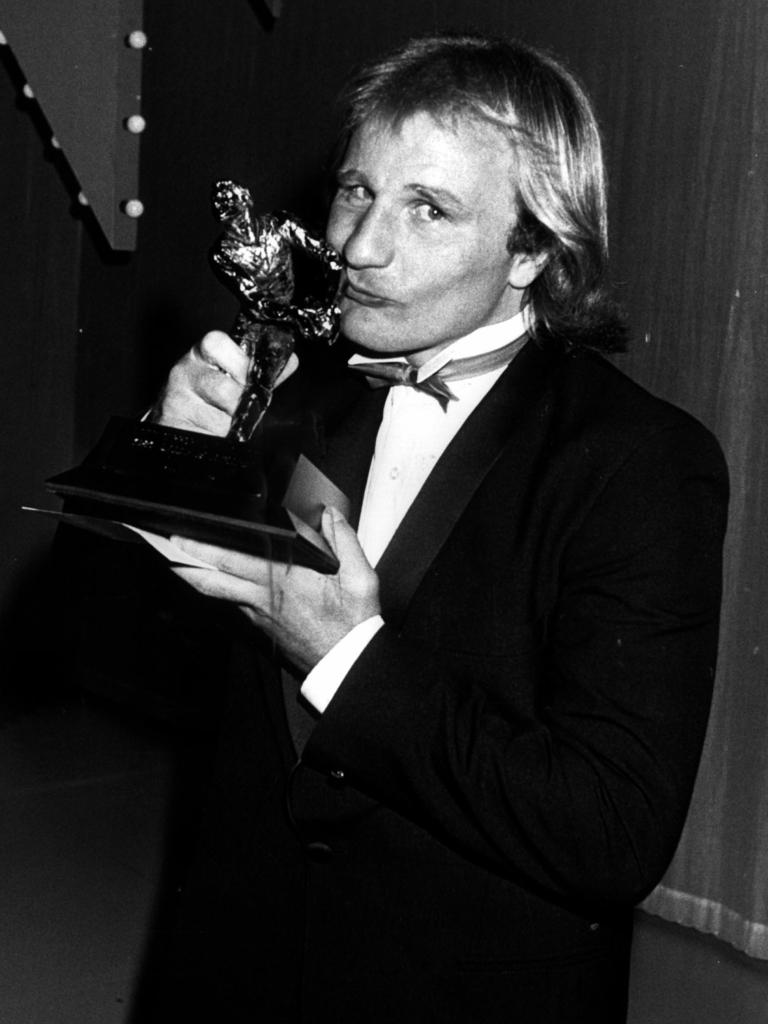

Like all the great halfbacks before and since, the NRL hall-of-famer was creative but a perfectionist – making the most intricate skills look simple, as Cleary did in 2021. But like Cronk, he too didn’t fully understand how to influence the tempo and momentum of a game until he was at least in his mid 20s.
“It points to what kind of player Nathan’s going to be in three or four years’ time if he has such an innate understanding of the game now,” Sterling continues.
“It didn’t happen for me until my mid-20s, and probably only when I needed to take on the responsibility that he’s already done. When Cronin and Price retired in ’86 … actually, we didn’t have a lot of success after that so maybe I didn’t take it on well.
“But it was mid-20s for me before I was called upon then to look at the game the way Nathan has done since he was 21. If he’s so composed and confident and calm now, he’s only going to get better at that.”
*****

Andrew Johns is considered by most to be the best halfback of all time but even he’s not convinced it will stay that way if Cleary continues his progression.
The young Panther is unlikely to give us an iconic image like skateboarding shirtless in a red and blue bowler hat with beer in hand, but if you can overlook the stark generational difference in how the two champions celebrated their first premiership, the similarities are there.
Johns changed rugby league with his kicking game and by the end of his career was creating new tricks just for fun. He mastered the game and then revolutionised it to his own whim. In 2021 Cleary’s kicking game went to a new level when he began strangling opposition sides for possession, but his ruthless performance in the grand final was a masterclass in execution.
This was all while swallowing the pain of a shoulder injury that would have ended the season for most. Like Joey did for Newcastle in the 1997 decider with a punctured lung and busted ribs, Cleary battled on. There we saw the same toughness and determination echoed on a modern stage.

Back in August, the eighth Immortal conceded in a column for the Sydney Morning Herald that he and Johnathan Thurston could be fighting for silver and bronze by the time the Penrith No. 7 hangs up his boots, even if that is at least another decade from now. Thurston had that toughness too, and his perfectionism nearly drove his teammates around the bend as it all came down to winning.
Along with Johns, Canberra hero Ricky Stuart had a similarly quick rise to Cleary. In the year he turned 24, the Raiders halfback had played four seasons of first grade, three of which resulted in grand finals for two premierships in a team stacked with talent, just like Sterling. He’s the only other legendary halfback to have won a Clive Churchill Medal by Cleary’s age (1990), although Johns (1998) and Thurston (2005 and 2007) had both claimed a Dally M Medal as the best players in the competition by 24.
Allan Langer achieved all of his success later, not winning his first premiership until he was 26 after Brisbane were added to the competition. But as a comparison to Cleary, across his first six seasons he claimed two premierships, a Rothman’s medal (1992), a Clive Churchill Medal (1992), three Origin series for Queensland and a remarkable 72 per cent win rate from 121 first grade games. With one less game (120), Cleary has a 67 per cent win rate – equal to Stuart (87 games) and better than Johns (63 per cent from 102 games) and Thurston (63 per cent from 97 games) at the same age.
*****

Cleary’s toughness showed up right from the start of his career while his flair was still brewing. Debuting for the Panthers in 2016, the 18-year-old put his defensive tenacity on show with 38 tackles against Melbourne.
The spotlight was already on him as the son of NRL coach Ivan Cleary, and naturally, Cronk took notice as the opposing halfback. From that night six years ago until the end of the 2021 season, Cleary grew from a halfback who did enough to skate by to a big-game winner.
“If you go back to when he was first playing Origin, there was a bit of criticism about how he was just a halfback who was making his tackles and kicking the ball, he wasn't really contributing in other ways,” Cronk says.
“On a surface level that's probably true. I think young halves should build their career that way. If you’re tenacious, you’re tough and you’re willing to make tackles and can kick the ball well, that’s a really good foundation to build a career on top of.
“If you come in looking for the big plays straight away, you struggle to go back and pick up all those lessons about toughness and physicality and being committed.
“When he was first started playing Origin, I thought he had enough will there to put skill on top of and obviously he‘s gone on now to have all the artillery in his kitbag to be able to produce on the bigger stage like he did the grand final.”
*****

Cleary’s week-by-week improvement blossomed into season-on-season development, where he has been among the top three, if not the best player in the competition for the past two years. His Clive Churchill Medal-winning performance in Penrith’s 14-12 win over Souths added more consideration into where he could sit among the greats of the game.
Sterling is less willing than Johns to make a case for Cleary’s ability to be the best of all time.
“I don’t want to get into the different eras and all of that,” he says.
“He’d have to be something to have the influence that Andrew Johns had on the game, but when it comes to success, maybe that’s the way we look at it, I see a lot more success coming Nathan’s way in whatever jersey he’s wearing.
“He’ll be an Origin player for many more seasons to come and that could equate to something spectacular, Penrith will be well-placed in the next couple of seasons, and he’ll play a lot of representative football.
“In regards to the best, I don’t enter into those conversations because it’s all subjective.
“But if I could be talking about him in the same breath that I do Andrew Johns or Allan Langer, or even a Steve Mortimer, then he‘s in rarefied air.”
Rugby league is a simple game and despite all the differences between the best-ever halfbacks across multiple generations, the same foundations remain. Cleary now has them all except longevity, which will come. It’s not for anyone but an oracle to say if Cleary will be the best ever – that’s up to the Penrith halfback himself.
But you’ll be hard-pressed to find someone brave enough to say he can’t be.

Lomax’s surprise code switch: Ex-Eels star takes up cricket

Cleary’s Panthers return locked in after Europe getaway with Fowler

‘Strange welcoming’: Brown’s unusual start to Newcastle life

NRL journeymen, sons of guns: Every club’s train and trial players

Pezet on deck as 150 Eels players gather for whole club hitout
